
Most people think they’re struggling with distraction.
But distraction is only the surface-level symptom.
The deeper issue is this:
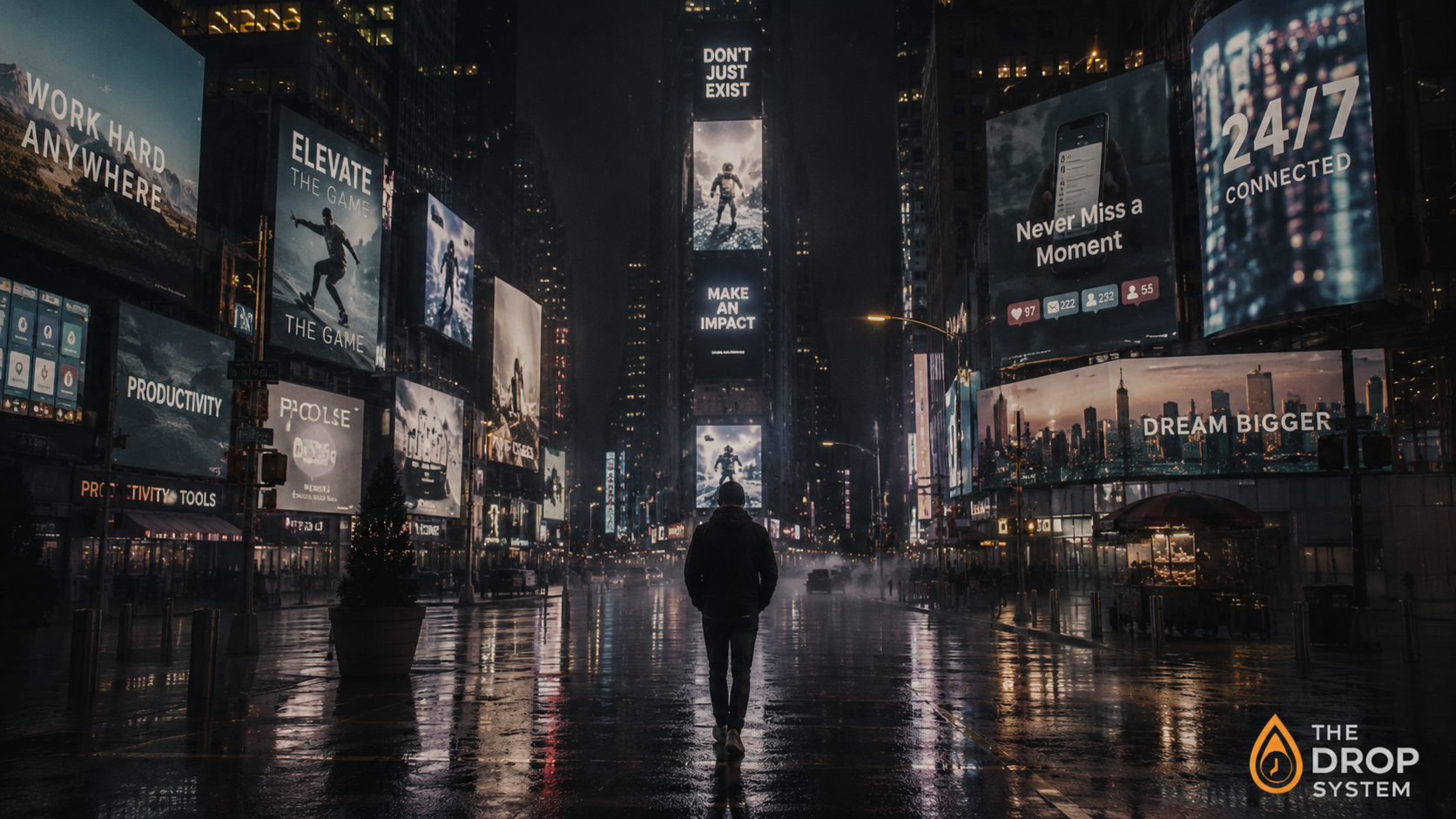
You are living inside an economy built around capturing and holding your attention for as long as possible.
That changes the environment more than most people realise.
Because once attention becomes profitable, interruption stops being accidental.
It becomes infrastructure.
Why this feels normal now
The modern digital environment has become so familiar that most people barely notice how aggressive it is anymore.
Notifications.
Infinite scroll.
Autoplay.
Recommended content.
Suggested videos.
“People also viewed.”
These are not random features.
They are retention mechanisms.
Their job is to keep you engaged longer.
And the longer billions of people stay engaged, the more profitable those systems become.
Again, this is not conspiracy thinking.
It’s business design.
The hidden mechanism: your attention has market value
This is the key shift most people haven’t fully absorbed.
Your attention is no longer just part of your internal life.
It is a commercial asset.
Technology companies compete for:
- your time
- your focus
- your emotional reaction
- your behavioural predictability
Why?
Because attention drives:
- advertising revenue
- data collection
- platform growth
- behavioural insight
- product dependency
The result is that many people are trying to protect their focus inside systems specifically engineered to dissolve it.
That’s a difficult environment to navigate without awareness.
Why exhaustion is becoming baseline
Many people now feel permanently mentally tired.
Not because they are physically overworked.
But because their attention is under constant demand.
Every alert creates:
- anticipation
- interruption potential
- micro-decision making
- cognitive switching
Even when you ignore notifications, your nervous system often remains partially engaged with the possibility of interruption.
That matters.
Because the brain does not recover properly when it remains in a low-level state of vigilance all day.
This is why some people:
- finish work mentally drained despite “not doing much”
- struggle to relax properly
- feel restless during quiet moments
- crave stimulation constantly
Their attention has been conditioned toward continuous engagement.
Most people are not failing. They are overloaded.
This distinction matters enormously.
The common narrative says:
- you lack discipline
- you procrastinate too much
- you need better habits
Sometimes habits matter.
But environmental exposure matters too.
Imagine trying to eat well while someone constantly places highly processed food in front of you every few minutes.
Willpower still matters.
But environment changes the difficulty level significantly.
Attention works similarly.
If this is resonating, you’ve got three options.
You can carry on reading and let it sit as awareness.
You can explore the books and start applying the framework in your own way.
Or, if you want structured support to actually install this properly and make it stick, you can join the training.
Explore the books on Amazon
Join the DROP online training
Why “taking a break” often doesn’t work anymore
Many people believe rest means:
- sitting down
- watching something
- scrolling casually
- consuming content
But passive consumption is not always cognitive recovery.
Sometimes it’s just lower-intensity stimulation.
Real recovery often requires:
- reduced input
- reduced switching
- reduced engagement demand
That’s becoming increasingly rare.
Many people now move from:
- work stimulation
directly into: - entertainment stimulation
Without ever fully disengaging cognitively.
That constant input creates fatigue even when the content itself feels harmless.
The cost most people don’t notice
The attention economy does not just affect productivity.
It affects depth.
Depth of:
- thinking
- conversation
- creativity
- reading
- presence
- reflection
Many people now struggle to:
- read long-form content properly
- stay with complex thoughts
- sit in silence comfortably
- focus deeply without checking something
Not because they are incapable.
Because their baseline stimulation threshold has shifted.
The DROP lens: attention is now the foundation layer
Traditional productivity systems usually start with:
- planning
- scheduling
- prioritisation
But increasingly, those things collapse without protected attention.
You cannot sustain:
- deep work
- thoughtful planning
- strategic thinking
- calm execution
…inside constant interruption.
That’s why attention protection is becoming foundational.
Not as a trendy idea.
As a practical necessity.
A realistic modern scenario
Think about the average evening.
You sit down intending to relax for 20 minutes.
Then:
- one notification appears
- you check a message
- a recommended video loads
- another article catches your attention
- you reply to something quickly
- an hour disappears
This isn’t because you’re weak.
It’s because multiple systems are designed to extend engagement once attention is captured.
Understanding that changes the conversation from:
“What’s wrong with me?”
to:
“What environment am I operating inside?”
That is a much healthier question.
What will feel uncomfortable
Once you become aware of this dynamic, you may notice how automatic many behaviours have become.
You may feel:
- urges to check your phone constantly
- discomfort during silence
- reflexive scrolling without intention
- anxiety when disconnected
That awareness can initially feel unsettling.
But awareness is where agency begins.
You cannot protect attention you do not realise is being consumed.
Why this matters beyond work
This affects:
- relationships
- parenting
- emotional regulation
- sleep
- creativity
- mental recovery
- identity
When attention becomes permanently fragmented, life starts feeling thinner.
Not necessarily worse.
Just shallower.
And many people feel that shift without fully understanding why.
Summary
The attention economy is designed to keep you engaged.
That does not mean technology is evil.
But it does mean your attention is constantly being competed for.
The result for many people is:
- exhaustion
- fragmentation
- reduced focus
- lower cognitive recovery
- difficulty reaching depth
Understanding this changes the goal.
The goal stops being:
“Become perfectly disciplined.”
And becomes:
“Create conditions where attention can survive.”
If you want to explore this work further
These ideas connect deeply into the wider work around attention, distraction and modern life.
If you want to explore those essays further, visit adamfoxofficial.com.
Or explore the books on Amazon to go deeper into the relationship between attention, behaviour and modern environments.