
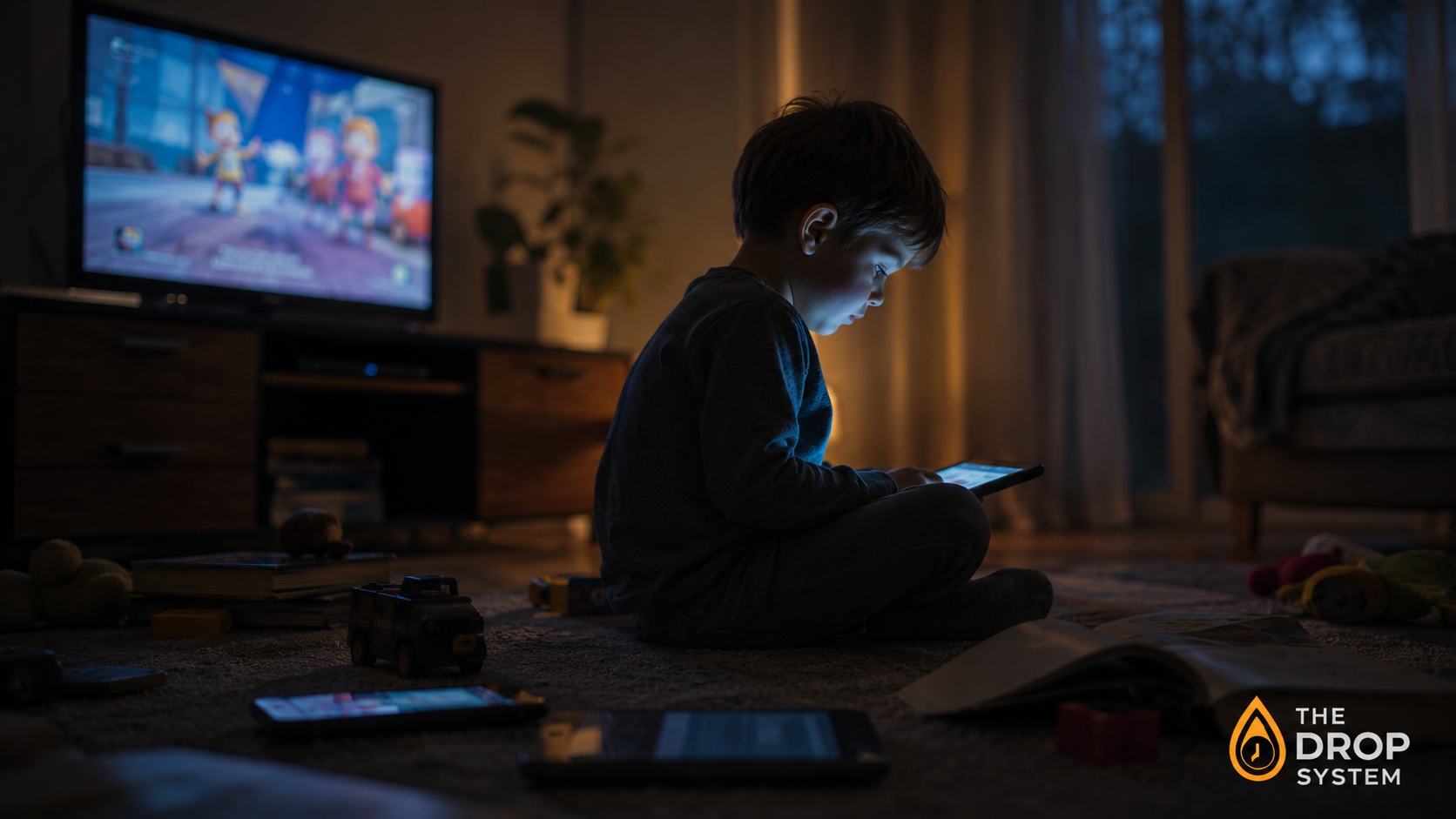
Most parents already sense that something has changed.
Not always dramatically.
Not always catastrophically.
But noticeably.
Children struggle to stay engaged with slower activities.
Boredom tolerance appears lower.
Attention shifts faster.
Screens become emotionally charged very quickly.
And underneath a lot of parental anxiety sits the same quiet question:
What is this doing to their brains long term?
That question deserves serious discussion without panic, exaggeration or moral grandstanding.
Because this is not really a conversation about “good parents” and “bad parents”.
It is a conversation about childhood attention developing inside environments that did not exist for previous generations.
Why this conversation matters
Most adults did not grow up with:
- smartphones in their pockets
- algorithmic entertainment
- endless short-form video
- constant notifications
- portable dopamine loops
Children now do.
That means modern childhood attention is developing under completely different conditions from previous generations.
And importantly:
those conditions are not neutral.
They shape behaviour.
The hidden mechanism: attention adapts to stimulation patterns
The brain adapts to repeated environments.
This is true for adults and especially true for children.
If attention is repeatedly exposed to:
- rapid novelty
- fast reward cycles
- endless stimulation
- constant switching
…the brain gradually begins expecting that level of stimulation more frequently.
This does not mean children are permanently damaged.
But it does mean attention patterns are being shaped differently.
That distinction matters enormously.
Why boredom used to matter more
Historically, boredom played an important developmental role.
Boredom often led to:
- imagination
- experimentation
- creative play
- problem solving
- reflection
- social interaction
Now boredom is increasingly interrupted immediately.
Waiting becomes screen time.
Car journeys become screen time.
Restaurants become screen time.
Quiet moments become screen time.
Again, this is not about blaming parents.
Modern life places enormous pressure on families.
But reduced boredom exposure changes childhood cognitive conditions significantly.
Why parents feel conflicted
Most parents already know screens can become excessive.
The difficulty is that modern digital tools also provide:
- convenience
- relief
- educational access
- social connection
- temporary calm
That creates tension.
Especially when parents themselves are also trying to manage:
- exhaustion
- work
- overstimulation
- modern attention demands
This is not a simple issue with simplistic solutions.
And pretending otherwise usually makes parents feel judged rather than supported.
If this is resonating, you’ve got three options.
You can carry on reading and let it sit as awareness.
You can explore the books on Amazon and start applying the framework in your own way.
Or, if you want structured support to actually install this properly and make it stick, you can join the training.
Why short-form stimulation changes attention expectations
A lot of modern content is optimised for:
- speed
- novelty
- rapid emotional response
- immediate engagement
This conditions the brain toward frequent stimulation shifts.
Over time, slower activities can begin feeling:
- frustrating
- under-stimulating
- difficult to sustain
This is one reason some children increasingly struggle with:
- reading
- sustained concentration
- quiet play
- long-form learning
- delayed gratification
Again:
not because children are failing.
Because environments shape expectations.
What many parents notice first
Parents often describe:
- children switching activities rapidly
- emotional reactions when devices are removed
- difficulty disengaging from screens
- reduced patience for slower tasks
- constant requests for stimulation
These patterns are increasingly common.
Not because children are weak.
Because modern platforms are highly effective at holding attention.
That is literally what many of them were designed to do.
The problem with framing this as “screen time”
This conversation is bigger than total hours.
Quality matters.
Context matters.
Interaction style matters.
There is a huge difference between:
- creative use
- passive consumption
- educational engagement
- endless algorithmic stimulation
The issue is not simply:
“screens bad”.
The issue is:
“What type of attention is being trained repeatedly?”
That is a far more useful question.
The DROP lens: protect childhood attention before rebuilding adult attention
A lot of adults are now trying to recover attention patterns that fragmented slowly over years.
Children are still developing those patterns in real time.
That creates an enormous opportunity.
Not for perfection.
But for awareness.
Helping children:
- tolerate boredom
- experience silence
- focus deeply
- engage with slower activities
- develop healthy relationships with technology
…may become one of the most important parenting challenges of the next decade.
A realistic family example
Imagine two different evenings.
Evening one
Everyone:
- scrolling separately
- watching individual content
- partially distracted
- reacting to notifications
Technically together.
But cognitively fragmented.
Evening two
Phones elsewhere.
Conversation.
Board games.
Reading.
Quiet play.
Shared attention.
The second environment often initially feels slower.
But many families notice:
- calmer interaction
- better conversation
- improved emotional presence
That difference matters more than people realise.
What will feel uncomfortable
Reducing stimulation often creates resistance initially.
Children may become:
- bored quickly
- frustrated
- restless
- emotionally reactive
That does not necessarily mean the change is harmful.
It may simply reflect how accustomed the nervous system has become to high stimulation environments.
And importantly:
adults experience this too.
Why this conversation will become bigger
As attention-related struggles continue increasing, more people are beginning to ask:
- what environments are shaping children?
- what happens when boredom disappears?
- what does endless stimulation do long term?
These questions are not anti-technology.
They are developmental questions.
And they deserve thoughtful discussion rather than panic or denial.
Summary
Smartphones and modern digital environments are shaping childhood attention in ways previous generations never experienced.
That does not mean technology is inherently harmful.
But it does mean attention patterns are increasingly being trained by:
- rapid stimulation
- endless novelty
- algorithmic engagement systems
Understanding that allows parents to become more intentional.
Not perfect.
Intentional.
And that may matter enormously over the coming decade.
If you want to explore this work further
These ideas connect directly into the wider work around attention, modern life and childhood cognitive development.
You can explore more essays and long-form thinking at adamfoxofficial.com
Or explore the wider body of work on Amazon