
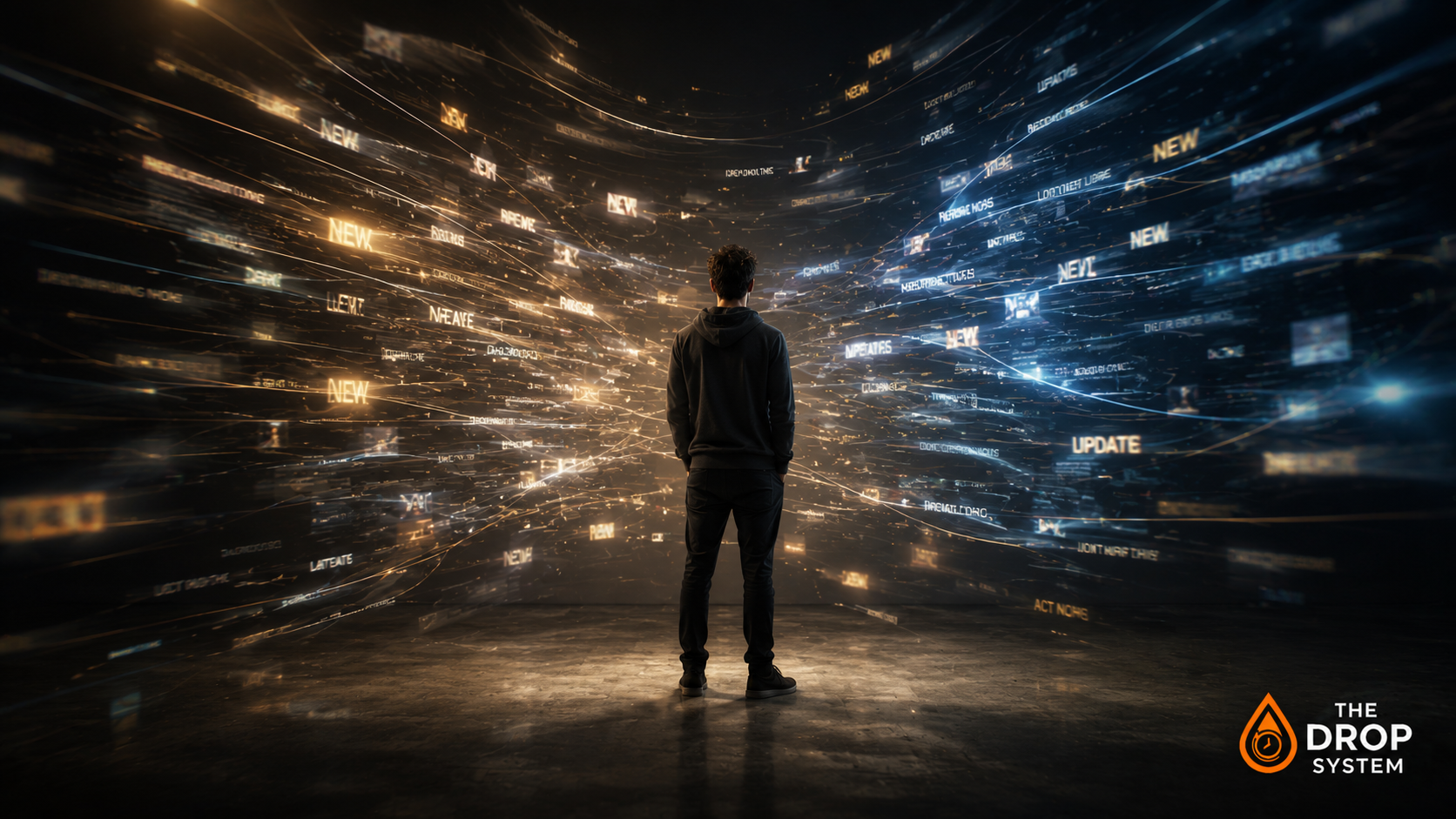
Ever found yourself opening your phone, checking the same three apps, finding absolutely nothing interesting, putting the phone down, then picking it up again thirty seconds later?
Of course you have.
We all have.
The strange thing is that most people know they are doing it.
They know the next scroll probably won’t change their life.
They know the next refresh probably won’t reveal anything important.
They know the next notification probably won’t matter.
Yet they check anyway.
Again.
And again.
And again.
Most people assume this is a discipline problem.
It isn’t.
At least not entirely.
The reality is far more interesting.
Your brain is doing exactly what it evolved to do.
The problem is that the modern world has figured out how to exploit that wiring better than ever before.
And once you understand that, a lot of your own behaviour suddenly starts making sense.
Your Brain Is Built to Notice What’s New
For most of human history, paying attention to something new was a survival advantage.
A movement in the bushes could be a predator.
A strange sound could be a threat.
A new food source could mean survival.
A new opportunity could mean status, resources or safety.
Novelty mattered.
The humans who noticed change tended to survive longer than the humans who ignored it.
So over thousands of generations, our brains became incredibly good at spotting things that were new, unusual or potentially rewarding.
That wiring still exists.
The only thing that has changed is the environment.
Your brain hasn’t evolved for social media.
It hasn’t evolved for smartphones.
It hasn’t evolved for infinite content.
It certainly hasn’t evolved for carrying access to the entire internet in your pocket.
Yet that’s exactly the environment it now finds itself operating in.
And that’s where things get messy.
The Dopamine Myth Everyone Gets Wrong
Let’s clear up one of the biggest misunderstandings on the internet.
Dopamine is not the “pleasure chemical”.
That’s a gross oversimplification.
Dopamine is far more closely linked to anticipation, motivation and seeking behaviour than simple pleasure.
In other words, dopamine is often released before the reward arrives.
Not after.
That distinction matters.
Because it explains why people keep checking things that aren’t even making them happy.
You don’t scroll because scrolling itself is necessarily enjoyable.
You scroll because your brain thinks something interesting might be coming next.
Maybe the next post will be funny.
Maybe the next message will be exciting.
Maybe the next notification will matter.
Maybe.
And that tiny uncertainty keeps the behaviour going.
The reward isn’t necessarily what you’re consuming.
The reward is often the possibility of finding something worthwhile.
That possibility is incredibly powerful.
Why Slot Machines and Social Media Feel Strangely Similar
Casinos figured this out decades ago.
The most addictive reward systems are not predictable ones.
They are variable ones.
If a slot machine paid out every tenth pull, it would be less compelling.
The uncertainty is what keeps people engaged.
Maybe the next one wins.
Maybe it doesn’t.
Social media platforms operate in remarkably similar ways.
Not because they are identical.
But because they use the same psychological principle.
You never know what is coming next.
The next video could be brilliant.
The next post could be fascinating.
The next message could change your day.
The next notification could be important.
That uncertainty creates engagement.
And engagement keeps people scrolling.
The problem is that your brain treats this as meaningful activity even when it is mostly consuming noise.
Why You Can Feel Overstimulated and Bored at the Same Time
This sounds impossible until you’ve experienced it.
Yet millions of people live in this state every day.
Their brain is overloaded.
Their attention is exhausted.
Their nervous system feels fried.
Yet they still feel bored.
How?
Because stimulation and fulfilment are not the same thing.
You can consume content for six straight hours and still feel unstimulated in any meaningful sense.
You can scroll endlessly and still feel unsatisfied.
You can jump between apps all evening and still feel restless.
That is because much of modern stimulation is shallow.
It occupies attention without necessarily creating meaning.
It fills time without necessarily creating satisfaction.
It keeps the brain busy without necessarily making life feel richer.
Which is why people often finish a long scrolling session feeling oddly empty.
Their brain received stimulation.
But not necessarily fulfilment.
The Hidden Cost of Constant Novelty
The more novelty your brain consumes, the more novelty it begins to expect.
That has consequences.
Activities that once felt normal can start feeling slow.
Books feel harder.
Conversations feel harder.
Deep work feels harder.
Reflection feels harder.
Even rest can feel harder.
Because these activities operate at a completely different pace.
They require patience.
They require sustained attention.
They require you to stay with one thing for longer than a few seconds.
That becomes difficult when your brain is used to receiving a fresh hit of novelty every few moments.
This doesn’t mean your attention span is broken.
It means your attention span is adapting.
And adaptation works both ways.
Just as attention can become fragmented, it can also be rebuilt.
The Attention Economy Depends on This Behaviour
There is a reason so many platforms are designed around endless engagement.
Your attention is valuable.
Extremely valuable.
In fact, attention is now one of the most valuable commodities on earth.
Every extra second you spend on a platform creates value for somebody.
Advertising value.
Data value.
Revenue value.
The longer you stay, the more profitable you become.
That does not mean every platform is evil.
But it does mean their objectives are often different from yours.
Your objective might be:
- Focus
- Presence
- Clarity
- Recovery
- Meaningful connection
Their objective is often:
- Engagement
- Retention
- Screen time
- Usage frequency
Those goals are not always aligned.
And understanding that helps explain why constant stimulation has become the default state of modern life.
What This Looks Like in Real Life
You sit down to work.
Five minutes later you check your phone.
Nothing important.
Back to work.
Ten minutes later you check again.
Then email.
Then Teams.
Then WhatsApp.
Then LinkedIn.
Then back to work.
You never consciously decided to do this.
Your brain simply followed the path it has practised thousands of times before.
Seeking novelty.
Seeking stimulation.
Seeking the possibility that something interesting might be waiting.
The behaviour feels normal because it has become normal.
That is why awareness matters.
Because you cannot change patterns you do not notice.
The DROP Lens: Intentional Stimulation vs Constant Stimulation
The DROP System stands for:
Dump
Review
Offload
Plan
Most people discover DROP through productivity.
But underneath productivity sits attention.
Because if attention is fragmented, everything else becomes harder.
You make worse decisions.
You become more reactive.
You lose clarity.
You struggle to focus on what actually matters.
The goal is not eliminating stimulation.
That would be unrealistic.
Life should contain stimulation.
Life should contain excitement.
Life should contain novelty.
The goal is becoming intentional about it.
Choosing stimulation instead of being controlled by it.
Creating moments of focus instead of constantly reacting.
Building a life where your attention serves you rather than everybody else.
That is a very different thing.
Mid-Article Reality Check
You are not weak because you struggle to put your phone down.
You are not lazy because you get distracted.
You are not broken because your attention feels fragmented.
You are a human being operating inside systems specifically designed to capture and retain attention.
Understanding that is not an excuse.
It is awareness.
And awareness is where change starts.
That is one of the reasons The DROP Revolution resonates with so many people.
It replaces self-blame with understanding.
Then it gives people practical ways to take control back.
If you’d like help doing exactly that, you can Explore the books or Join the DROP System training.
How To Reduce The Need For Constant Stimulation
You don’t need a digital detox.
You don’t need to move into a forest.
You don’t need to throw your phone in a lake.
Start smaller.
Try:
- Walking without headphones occasionally
- Leaving your phone in another room during focused work
- Reading for ten minutes without interruption
- Turning off non-essential notifications
- Sitting with boredom instead of immediately escaping it
- Watching a film without simultaneously scrolling
- Creating short periods of intentional silence
None of these things sound dramatic.
That is exactly why they work.
The goal is not perfection.
The goal is slowly rebuilding your ability to stay present without needing constant novelty.
The Bigger Question
Perhaps the most important question isn’t:
“Why does my brain crave stimulation?”
Perhaps it is:
“What is all this stimulation preventing me from noticing?”
Because the moment the noise stops, interesting things often appear.
Thoughts you’ve been avoiding.
Decisions you’ve been delaying.
Conversations you’ve been putting off.
Ideas you’ve never had space to think about properly.
That is one reason people often find silence uncomfortable.
Silence removes distractions.
And when distractions disappear, reality gets louder.
Many people spend years unconsciously running from that.
Summary
Your brain craves constant stimulation because it evolved to notice novelty, uncertainty and potential rewards.
That wiring once helped human beings survive.
Today it is being exploited by technologies capable of delivering endless novelty on demand.
The result is a world where many people feel simultaneously overstimulated and unsatisfied.
Understanding this changes everything.
Because once you realise the behaviour is being driven by ancient wiring operating inside a modern environment, you can stop blaming yourself and start changing the environment instead.
The goal is not eliminating stimulation.
The goal is becoming intentional about it.
Because the more control you regain over your attention, the more control you regain over your life.
If this article resonates, you might enjoy What Your First 30 Days With DROP Actually Look Like