
This is the quiet question behind most buying decisions.
Not “Does it sound good?”
But:
How long until I actually feel a difference?
If you’ve tried productivity systems before, you may be wary of big promises.
So let’s remove exaggeration.
Real structural change does not happen overnight.
But it also doesn’t take a year to feel a shift.
Most people see results in stages.
Why people misjudge timelines
When people ask how long it takes to see results, they usually mean one of two things:
- How long until I feel less overwhelmed?
- How long until I get time back?
Those are related, but not identical.
The mistake is expecting both at the same time.
Clarity comes before time recovery.
Stability comes before optimisation.
If you measure early progress using the wrong metric, you’ll assume nothing is happening.
The hidden mechanism: early wins vs deeper change
Structural systems produce two types of results:
- Immediate friction reduction
- Long-term behavioural shift
Immediate wins are visible quickly.
Behavioural change compounds over months.
If you only look for dramatic time freedom in week one, you’ll miss the first category entirely.
Let’s break it down properly.
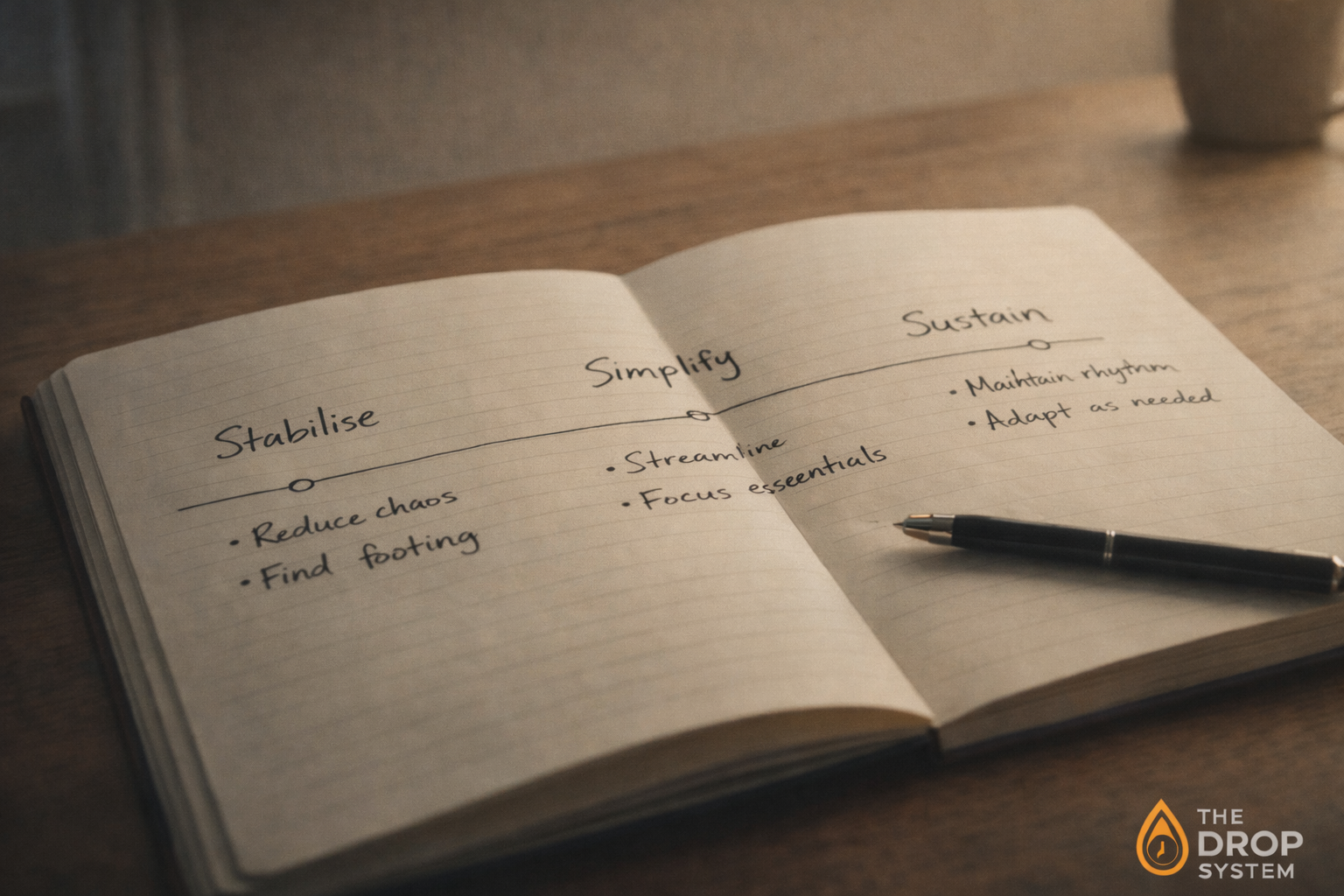
Stage 1: Stabilise (Weeks 1–2)
This is the containment phase.
You:
- Capture everything properly
- Start reviewing consistently
- Stop relying on memory
- Define a small number of clear priorities
Most people notice within the first two weeks:
- Fewer forgotten tasks
- Reduced background mental noise
- Clearer weekly direction
- Less time spent deciding what to do next
You may not yet have “more time”.
But you usually have more control.
That’s the first result.
Stage 2: Simplify (Weeks 3–6)
This is where Offload becomes more meaningful.
You begin to:
- Remove low-value commitments
- Delegate more intentionally
- Plan around realistic capacity
- Stop over-scheduling your days
This is where time recovery often begins.
Not because you suddenly work less.
Because you work cleaner.
Here’s a realistic example.
If you reduce:
- 20 minutes per day of friction
- Across 5 days per week
- For 46 working weeks
That’s 76 hours per year.
That’s nearly two full working weeks.
Even if only half of that becomes usable time, that’s still material.
But this stage requires consistent review.
Without review rhythm, simplification stalls.
Stage 3: Sustain (Months 2–6)
This is where structure becomes default.
You no longer debate whether to capture.
You no longer skip review unless something exceptional happens.
You no longer plan fantasy days.
At this stage, people often report:
- Noticeably lower stress baseline
- Higher completion rates
- Less evening spillover
- More strategic thinking time
- More presence outside work
This isn’t dramatic.
It’s steady.
But steady is what holds.
What usually changes first
If we’re being precise, this is the typical order:
- Mental clarity improves
- Decision fatigue reduces
- Completion rates increase
- Reactive work decreases
- Time recovery follows
Many people expect number five first.
But time recovery is usually the outcome of structural consistency, not the starting point.
Why some people don’t see results quickly
If someone says, “I tried it for a month and nothing changed,” it’s usually one of three things:
- Review rhythm wasn’t consistent
- Offload wasn’t applied properly
- Planning remained optimistic
Remember:
Dump without Review creates a bigger list.
Review without Offload creates clarity without relief.
Plan without realism recreates pressure.
The sequence matters.
Consistency matters more.
A realistic timeline expectation
If you’re adopting DROP properly, a grounded expectation looks like this:
Week 1–2:
Clarity increases. Mental noise reduces.
Week 3–6:
Planning improves. Friction hours reduce.
Month 2–3:
Time recovery becomes visible.
Month 3–6:
Behaviour stabilises. Stress baseline lowers.
Beyond 6 months:
Structure feels normal, not effortful.
This isn’t a guarantee.
But for many people, this is a reasonable pattern.
What will feel uncomfortable
Early structure can feel slow.
You may think:
“I’m spending time organising instead of doing.”
That feeling usually fades once you see:
- Fewer last-minute rushes
- Fewer forgotten commitments
- Fewer rework loops
Another discomfort point is letting go.
Offloading and reducing commitments often requires:
- Saying no
- Delegating imperfectly
- Reducing personal involvement
That takes practice.
But it’s often where the largest gains sit.
What results actually look like
It helps to define what “results” mean clearly.
Results are not:
- A permanently empty inbox
- Zero stress
- Perfect weeks
Results are more likely to be:
- Fewer open loops
- Clear weekly priorities
- Lower decision friction
- Higher completion rates
- Noticeable reduction in mental clutter
Those are structural results.
They’re less dramatic, but more durable.
The long-term perspective
Productivity systems that promise overnight transformation tend not to last.
Systems that stabilise first and compound slowly tend to hold.
If you adopt DROP with the expectation of steady change rather than instant overhaul, you are more likely to see consistent results.
Because you’re measuring the right things.
Calm summary
How long does it take to see results?
Often:
- Clarity in weeks
- Simplicity in a month
- Time recovery in a few months
- Sustainable change over longer horizons
The key is not intensity.
It’s consistency.
If you maintain the sequence — Dump, Review, Offload, Plan — the results tend to compound.
If you want help applying this, here’s the next step
If you want guided support through the stabilise–simplify–sustain stages, with structure that helps the system hold under real pressure, you can join the DROP online training.
Leave a Reply