
When people look at a new system, one question sits underneath everything else:
What will this actually look like in real life?
Not in theory.
Not in a perfect week.
Not when motivation is high.
But in the middle of meetings, inbox noise, family commitments and limited energy.
If you’re considering adopting DROP, it helps to remove fantasy from the equation.
The first 30 days are not dramatic.
They are stabilising.
Why most people misjudge the early stage
A common mistake with any productivity framework is expecting instant transformation.
Clear desk.
Perfect calendar.
Zero backlog.
That expectation creates disappointment.
The early phase of structural change is not optimisation. It’s containment.
Most systems fail in month one because people try to redesign their entire life at once.
DROP works differently.
The first 30 days are about reducing decision friction and stabilising the load.
The hidden mechanism: instability before structure
When you introduce structure, two things happen simultaneously:
- You see the full weight of your workload.
- You realise how much was previously unmanaged.
That visibility can feel uncomfortable.
Many people interpret that discomfort as failure.
It isn’t.
It’s exposure.
Exposure is required before simplification.
Week-by-week: what actually changes
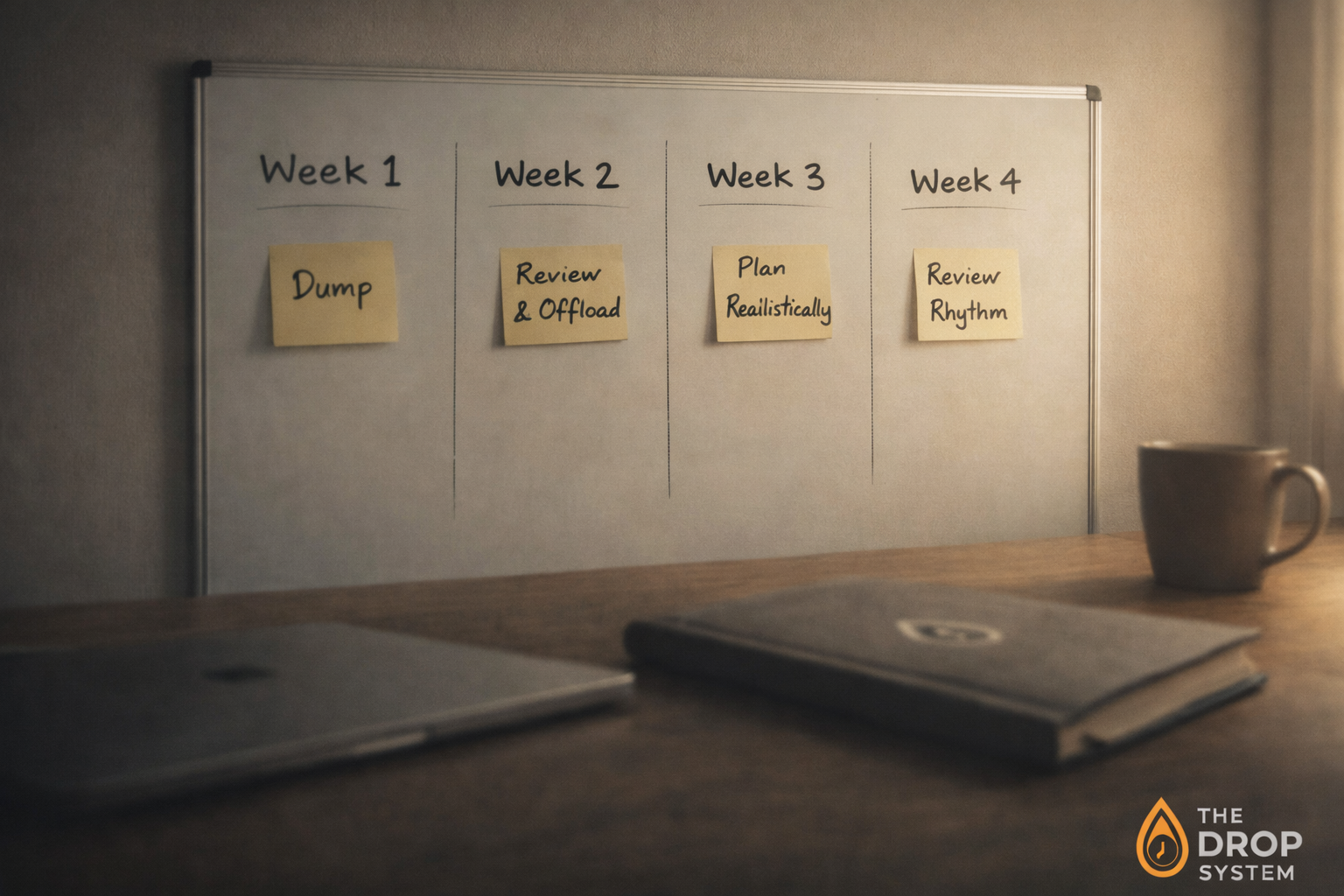
Week 1 – Containment
The focus is Dump and basic Review.
You externalise everything:
- Tasks
- Ideas
- Loose commitments
- Follow-ups
- “I must remember…” thoughts
Most people underestimate how much is floating in their head.
In Week 1, you may feel temporarily more aware of the workload.
That’s normal.
You are moving from hidden chaos to visible structure.
What changes:
- Reduced mental noise
- Fewer “Oh I forgot” moments
- A clearer sense of what exists
What doesn’t change yet:
- Total workload
- Energy levels
- Backlog size
This is a stabilisation week.
Week 2 – Clarification
Now Review becomes sharper.
You start asking:
- Does this actually matter?
- Does this belong with me?
- Is this current or historical?
Offload begins here.
That might mean:
- Delegating properly
- Deleting low-value commitments
- Renegotiating deadlines
- Parking ideas intentionally
You’ll likely feel resistance here.
Offloading challenges identity, especially if you’re used to being the reliable one.
What changes:
- Fewer unnecessary tasks
- Clearer weekly priorities
- Slight reduction in reactive behaviour
What doesn’t change yet:
- The fact that you’re still busy
This isn’t about suddenly working fewer hours. It’s about working cleaner hours.
Week 3 – Realistic planning
By now, Dump and Review are becoming routine.
Week 3 is where Plan becomes more grounded.
Instead of scheduling ideal days, you start planning based on:
- Actual capacity
- Known energy patterns
- Realistic time blocks
Many people discover they’ve been overestimating daily capacity by 20–30%.
For example:
If you believe you can complete eight meaningful tasks per day but realistically complete five, that gap creates daily disappointment.
Reducing planned output to five improves completion rates immediately.
Same effort.
Higher completion ratio.
That shift builds confidence.
Week 4 – Maintenance rhythm
The final week of the first 30 days is about rhythm.
Short daily check-ins.
A weekly review reset.
Clear priority boundaries.
This is where most systems either stick or fade.
The key realisation in Week 4 is this:
Maintenance is the point.
You are not trying to build a perfect week.
You are building a repeatable sequence:
Dump → Review → Offload → Plan.
Consistency here matters more than intensity.
Common wobble points (and how to recover)
Nearly everyone hits friction during the first month.
Here are the most common wobble points.
Wobble 1: Overbuilding the system
Some people respond to clarity by adding complexity:
- More categories
- More tags
- More sub-lists
Simplicity wins.
If you find yourself reorganising more than executing, reduce.
Return to one capture point. One review rhythm.
Wobble 2: Skipping reviews
The daily work feels urgent, so the weekly review gets postponed.
Without Review, the system degrades.
If you miss a week, don’t restart from scratch.
Do a short reset:
- 20-minute Dump
- 20-minute Review
- Reconfirm top three outcomes
Then continue.
Wobble 3: Expecting immediate time freedom
The first 30 days are about control, not massive time recovery.
Control comes first.
Efficiency follows.
If you judge the system purely by “hours saved” in Month 1, you may miss the structural gain.
Look instead at:
- Fewer forgotten tasks
- Clearer priorities
- Lower decision fatigue
- More completed outcomes
Those are leading indicators.
A realistic 30-day snapshot
Here’s what often shifts within the first month:
Before:
- 40–60 open loops in your head
- No consistent review habit
- Frequent reactive days
- Planning based on optimism
After 30 days:
- Single trusted capture location
- Weekly review habit installed
- Clear top priorities each week
- Planning based on capacity
- Noticeable reduction in “mental tabs”
Not perfect.
But stable.
Stability is the foundation for deeper change.
What doesn’t magically happen
It’s important to be clear.
In 30 days you probably won’t:
- Eliminate all stress
- Halve your working hours
- Remove every urgent request
- Create perfect boundaries
What you will likely gain is structural control.
And control reduces background anxiety.
That alone is significant.
Why this stage determines long-term success
Many productivity systems fail because Month 1 is treated as an experiment rather than an installation phase.
DROP works when the sequence becomes default.
When you no longer debate:
- Whether to capture
- Whether to review
- Whether to offload
- Whether to plan
You simply do.
The first 30 days are about building that default.
Calm summary
The first 30 days with DROP are not about dramatic reinvention.
They are about:
- Containment
- Clarification
- Realistic planning
- Maintenance rhythm
You will likely feel:
- More aware at first
- Slight resistance when offloading
- Gradual clarity building week by week
If you stay with the sequence, stability replaces mental noise.
That’s the real early win.
If you want help applying this, here’s the next step
If you want structured guidance through those first 30 days — including how to handle wobble points and build the review rhythm properly — you can Join the online training here.
It’s designed to support implementation, not just understanding.
Leave a Reply