
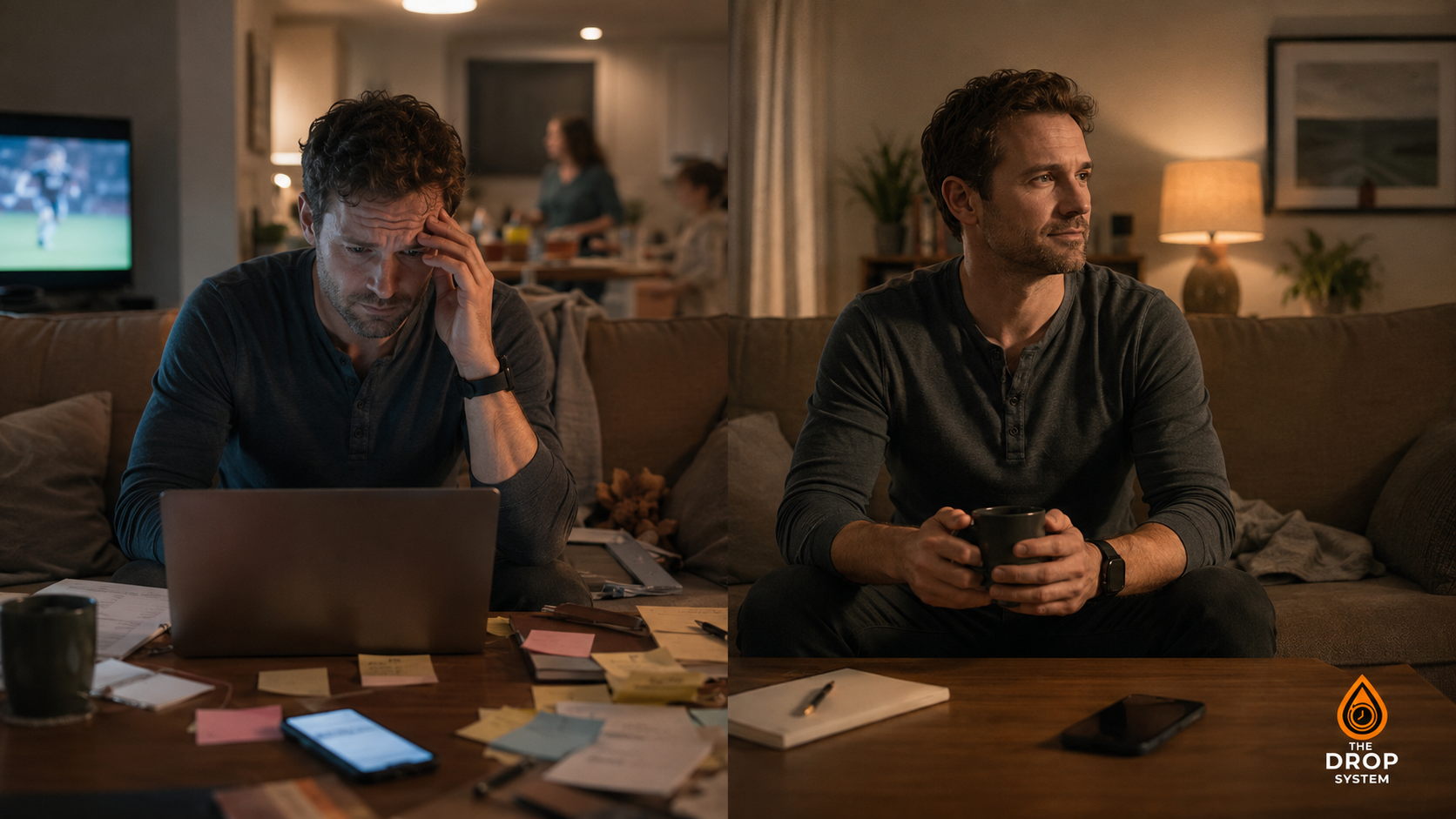
You finally sit down after a busy day.
Nothing is obviously wrong.
There is no emergency.
Nobody is demanding anything from you.
Yet your body still feels tense.
Your thoughts are moving too quickly.
You feel restless without knowing what you are supposed to be doing.
Your phone is nearby, but checking it does not help.
The television is on, but you are barely watching it.
You try to relax, but your mind seems unable to follow.
Many people describe this feeling as anxiety.
Sometimes that is exactly what it is.
But there is another possibility we do not discuss nearly enough.
You may be overstimulated.
The hidden link between overstimulation and anxiety matters because the two can feel remarkably similar.
Both can leave you restless.
Both can make it difficult to concentrate.
Both can disrupt sleep.
Both can create physical tension.
Both can make ordinary demands feel harder to manage.
And because modern life keeps adding more information, noise, notifications and decisions, many people are living in a state of overstimulation without recognising it.
This does not mean all anxiety is caused by too much stimulation.
Anxiety is complex and can have many causes.
But it does mean that constantly overwhelming your attention can create or intensify feelings that look and feel like anxiety.
That distinction gives you something practical to work with.
What Is Overstimulation?
Overstimulation happens when your brain and nervous system receive more input than they can comfortably process.
That input can come from almost anywhere:
- Noise
- Bright lights
- Crowded environments
- Screens
- Notifications
- Social media
- Difficult conversations
- Constant decision-making
- Too many unfinished tasks
- Rapidly changing information
- Emotional content
- Being interrupted repeatedly
One source of stimulation may be completely manageable.
The problem is often accumulation.
A noisy commute.
A full inbox.
Back-to-back meetings.
Messages arriving throughout the day.
Children needing attention.
A television playing in the background.
News updates.
Social media.
Work continuing into the evening.
None of these things alone necessarily causes a problem.
Together, they can leave the brain with nowhere to settle.
Overstimulation is not simply having a busy day.
It is reaching the point where your system struggles to filter, prioritise and process everything coming in.
The Link Between Overstimulation and Anxiety
The link between overstimulation and anxiety becomes clearer when you look at what both states do to the body and mind.
When you feel anxious, you may become more alert to possible problems.
Your muscles tense.
Your heart rate may increase.
Your thoughts speed up.
You find it harder to ignore uncertainty.
You scan for what needs attention.
Overstimulation can produce a similar experience.
Your brain is exposed to more movement, sound, information and demands than it can comfortably process.
It remains alert because something new keeps arriving.
You become more reactive.
Small interruptions feel bigger.
Simple decisions feel harder.
Ordinary noise becomes irritating.
Your body may feel as though it needs to escape, even when there is no obvious danger.
The experience can be deeply uncomfortable.
And because there is often no single cause to point towards, people may conclude that they are anxious for no reason.
There may be a reason.
The reason may be that their system has not had enough opportunity to recover.
Your Brain Is Trying to Filter Too Much
You are constantly surrounded by information that your brain must decide whether to notice or ignore.
A conversation nearby.
A vibration in your pocket.
An email notification.
Movement on a screen.
A child asking a question.
A thought about unfinished work.
Traffic noise.
A headline.
A message preview.
Most of this filtering happens automatically.
You are not consciously deciding whether every sound or movement matters.
Your brain does that work in the background.
But background work still uses capacity.
When the amount of incoming information becomes too great, filtering gets harder.
You notice more.
You become distracted more easily.
Sounds feel sharper.
Interruptions feel more intrusive.
Your tolerance drops.
That can create a sense of being on edge.
Not because one particular thing is threatening you.
Because your brain is struggling to determine what deserves attention.
As explored in [link to: “What Constant Input Is Doing to Your Brain”], information does not need to be important to consume mental energy. It only needs to arrive.
Anxiety Can Make Stimulation Feel Stronger
The relationship works in both directions.
Overstimulation can make you feel more anxious.
Anxiety can also make ordinary stimulation feel more intense.
When you are already tense or worried, your brain may become more sensitive to possible threats and demands.
A loud room feels louder.
A busy shop feels more overwhelming.
A stream of messages feels harder to manage.
A crowded calendar feels impossible.
A small interruption feels like the final straw.
This can create a difficult cycle.
You feel anxious, so your tolerance for stimulation falls.
The environment then feels more overwhelming.
That increased overwhelm creates more anxiety.
Without recognising the cycle, you may keep adding stimulation in an attempt to escape the discomfort.
You scroll.
Watch something.
Check messages.
Listen to a podcast.
Look for reassurance online.
Those activities may distract you briefly.
But they also give your brain more to process.
Why Your Phone Can Make the Feeling Worse
Your phone often becomes the first thing you reach for when you feel uncomfortable.
That makes sense.
It offers distraction, connection and immediate novelty.
But it also contains almost every type of stimulation in one place.
Messages.
Work.
News.
Social media.
Videos.
Opinions.
Reminders.
Shopping.
Music.
Games.
Each time you check, your brain may encounter something emotionally or mentally demanding.
An unanswered email.
Somebody else’s bad news.
A political argument.
A reminder about work.
A message requiring a decision.
A post that triggers comparison.
You picked up the phone to feel better.
Instead, you added another layer of input.
The relief may last for a few seconds.
Then your mind feels even fuller than before.
This does not mean your phone causes every anxious feeling.
It means automatic phone use can intensify overstimulation precisely when your brain needs less input.
Emotional Content Still Counts as Stimulation
People often associate overstimulation with loud noise, bright lights or crowded places.
Emotional stimulation matters too.
Social media exposes you to rapidly changing emotional material.
A funny video.
A tragic story.
A successful friend.
An angry argument.
A frightening headline.
A family update.
A financial warning.
A motivational speech.
Your brain must repeatedly change emotional direction.
You may move from amusement to concern to envy to anger within a few minutes.
That emotional switching is tiring.
It also makes it difficult for your nervous system to return to a calmer baseline.
Nothing terrible may have happened directly to you.
But your body has still responded to dozens of emotionally loaded cues.
This is one of the reasons [link to: “Why Social Media Leaves People Mentally Drained”] is so important. Passive consumption is often far less passive than it appears.
Overstimulation Can Look Like Irritability
Not everybody experiences overstimulation as obvious anxiety.
Sometimes it appears as irritability.
A colleague asks a simple question and you feel disproportionately annoyed.
Your child makes a normal amount of noise and it feels unbearable.
Someone speaks to you while you are reading an email and you snap.
The television is too loud.
The room feels too busy.
One more notification feels like an attack.
You may believe the people around you are the problem.
Sometimes they are simply the final source of input your brain can no longer absorb.
This does not excuse poor behaviour.
But it can explain why your patience disappears so quickly.
Your reaction may not be about the final interruption.
It may be about the hundreds that came before it.
Decision Fatigue Adds to the Pressure
Modern life requires constant decisions.
What should you answer?
What can wait?
Which task comes next?
Should you accept the meeting?
Do you need to reply now?
What should you cook?
What should you watch?
Which headline is trustworthy?
Should you buy the product?
Should you respond to the comment?
Many of these decisions are tiny.
Together, they create pressure.
Every decision asks your brain to evaluate information and choose a response.
When your mental capacity is already stretched, even simple choices can begin feeling overwhelming.
You may avoid decisions.
Make impulsive choices.
Become frustrated.
Or feel anxious because everything seems to require attention at once.
This is one reason removing unnecessary decisions can create such immediate relief.
You are not becoming less capable.
You are reducing the number of demands competing for limited mental capacity.
Why Overstimulation Often Gets Worse in the Evening
Many people feel relatively functional during the day but become increasingly restless, irritable or anxious in the evening.
That can seem confusing.
Work has finished.
The main demands have reduced.
You should be able to relax.
But your brain has been absorbing input all day.
By evening, your capacity to filter and regulate may be depleted.
Then more stimulation arrives.
Television.
Scrolling.
Messages.
News.
Online shopping.
Multiple screens.
Instead of helping the brain recover, the evening continues the same pattern in a different form.
Your body is sitting down.
Your attention is still working.
That is why you can spend several hours apparently resting and still feel mentally exhausted at bedtime.
Rest is not simply the absence of work.
It is the reduction of demand.
Overstimulation Can Disrupt Sleep
Sleep requires a transition.
Your brain needs time to move away from alertness and towards rest.
Constant stimulation makes that transition harder.
You finish work late.
Check social media.
Read the news.
Reply to messages.
Watch fast-moving content.
Then expect your mind to become quiet the moment your head touches the pillow.
It often does not work like that.
Thoughts continue.
Conversations replay.
Ideas appear.
Unfinished tasks resurface.
You feel physically tired but mentally active.
Poor sleep then reduces your tolerance for stimulation the following day.
Noise feels more irritating.
Decisions become harder.
Focus weakens.
Emotions become more difficult to regulate.
The cycle begins again.
Overstimulation contributes to poor recovery.
Poor recovery makes overstimulation more likely.
Quiet Can Initially Make Anxiety Feel Stronger
One of the most frustrating parts of reducing stimulation is that the discomfort may become more noticeable before it improves.
You turn everything off.
The room becomes quiet.
Suddenly, your thoughts feel louder.
This can make it seem as though silence caused the anxiety.
It did not.
The stimulation was masking what your brain had not yet processed.
Quiet removes the distraction.
That can feel uncomfortable.
You remember unfinished tasks.
Notice physical tension.
Become aware of worries.
Feel the urge to pick up your phone.
This is where many people abandon quiet too quickly.
They assume it is making things worse.
In reality, their mind may be adjusting after hours of constant input.
As explained in [link to: “Why Quiet Feels So Uncomfortable Now”], stillness often feels unfamiliar before it begins to feel restorative.
The Difference Between Calming Down and Numbing Out
There is an important difference between calming yourself and numbing yourself.
Calming reduces pressure.
Numbing temporarily distracts you from it.
A quiet walk may help your nervous system settle.
Scrolling may simply stop you noticing that it has not settled.
Writing down your worries may reduce the need to keep rehearsing them.
Watching endless videos may postpone dealing with them.
Talking to somebody may create understanding.
Consuming more content may simply occupy the space where understanding could have formed.
Numbing is attractive because it works quickly.
The discomfort disappears for a moment.
But the underlying mental load remains.
Calming often feels slower.
It requires enough space for your body and thoughts to settle naturally.
That is not always comfortable.
It is usually more restorative.
The DROP Lens: Reduce the Load Before Managing the Feeling
The DROP System stands for:
Dump
Review
Offload
Plan
When you feel overwhelmed or anxious, the instinct may be to solve everything at once.
That usually creates more pressure.
DROP takes a different approach.
Dump everything that is competing for attention.
Tasks.
Worries.
Ideas.
Commitments.
Questions.
Things you fear you may forget.
Getting them out of your head reduces the need to keep mentally rehearsing them.
Then Review.
What is real?
What is urgent?
What can wait?
What belongs to somebody else?
Offload what should not remain with you.
Delegate it.
Delete it.
Defer it.
Discuss it.
Then Plan the few things that genuinely deserve attention.
The DROP Revolution is not a promise that you will never feel anxious or overwhelmed again.
It is a practical way to stop adding unnecessary mental load to an already stretched system.
To explore these ideas in more depth, Explore the books or Join the DROP System training.
How to Tell Whether You May Be Overstimulated
Overstimulation can feel different for different people.
Common signs include:
- Feeling unusually irritable
- Struggling to follow conversations
- Wanting everybody to stop talking
- Finding ordinary noise overwhelming
- Checking your phone repeatedly without purpose
- Feeling unable to make simple decisions
- Restlessness despite feeling tired
- Difficulty reading or concentrating
- Wanting to escape a busy environment
- Feeling mentally full
- Becoming emotional over small problems
- Struggling to relax after the demands stop
These experiences can also have other causes.
The point is not to diagnose yourself.
It is to become curious about what your mind and body may be responding to.
Ask:
How much input have I consumed today?
How many times have I been interrupted?
Have I had any genuine quiet?
Am I trying to rest through more stimulation?
What could I remove before adding another coping strategy?
Those questions may reveal patterns you have been overlooking.
Practical Ways to Reduce Overstimulation
You do not need to remove all stimulation from your life.
The aim is to create periods of lower demand so your system has a chance to recover.
Reduce simultaneous input
Do not scroll while watching television.
Do not listen to a podcast while replying to messages.
Do not keep email, chat and social media open while trying to think.
One input at a time is often enough.
Create quieter transitions
Leave a few minutes between meetings.
Drive home without audio occasionally.
Pause after work before turning on entertainment.
Give your brain time to move between states.
Turn off unnecessary alerts
Every notification asks your brain to evaluate whether something matters.
Remove the requests that do not need immediate access to you.
Lower the intensity of your environment
Dim bright lights.
Reduce background noise.
Move away from crowded spaces where possible.
Put your phone out of sight.
Small environmental changes can produce a surprisingly large sense of relief.
Write down what is circling in your mind
Unfinished thoughts create internal stimulation.
Capture them.
Your brain is more likely to release something when it trusts that it has been recorded.
Choose genuinely restorative activities
Walk.
Stretch.
Read something slow.
Sit outside.
Cook.
Talk to somebody without a screen present.
Rest does not need to mean doing nothing.
It means reducing demand.
When Anxiety Needs More Than Fewer Notifications
It is important not to reduce every anxious experience to overstimulation.
Persistent or severe anxiety may require professional support.
Speak to a qualified healthcare professional when anxiety is significantly affecting your sleep, work, relationships or everyday functioning.
Reducing stimulation can support wellbeing.
It is not a replacement for appropriate medical or psychological care.
The useful point is that your environment still matters.
Even when anxiety has deeper causes, constant noise, interruption and information overload may make symptoms harder to manage.
Protecting your attention is not a cure.
It is one way to stop placing additional strain on a system that may already be struggling.
What It Feels Like When the Load Begins to Drop
The change is not always dramatic.
You may simply notice that you are less reactive.
Noise bothers you less.
You can follow a thought to its conclusion.
You stop checking your phone every few minutes.
You feel more patient with people.
Decisions seem clearer.
Your body feels less tense.
You begin recognising when you have had enough input.
That awareness is valuable.
It allows you to respond before reaching the point where everything feels unbearable.
You stop treating overstimulation as something you must endure.
You start recognising it as a signal.
A sign that your brain needs less.
Not another app.
Not another video.
Not more advice.
Less.
Summary
The hidden link between overstimulation and anxiety lies in the way both affect attention, alertness and the nervous system.
Constant noise, notifications, emotional content, decisions and interruptions can keep the brain in a state of ongoing demand.
That may create:
- Restlessness
- Irritability
- Mental fatigue
- Physical tension
- Difficulty concentrating
- Trouble relaxing
- Increased sensitivity to noise and interruption
Overstimulation is not the cause of all anxiety.
But it can create anxious feelings and intensify anxiety that already exists.
The answer is not abandoning modern life.
It is recognising that your brain needs limits, recovery and periods when nothing new is asking for a response.
For a deeper understanding of the pressures contributing to overstimulation, read:
What Constant Input Is Doing to Your Brain
Why Modern Life Feels So Noisy
Why Quiet Feels So Uncomfortable Now
You cannot always control what happens around you.
But you can become more selective about what receives access to your attention.
You can reduce unnecessary alerts.
Stop layering multiple forms of stimulation.
Create quieter transitions.
Write down what your mind is trying to hold.
Give your brain a genuine chance to recover.
Sometimes the feeling that something is wrong does not mean you need to do more.
It means your system has already had enough.
To explore these ideas further, Explore the books or Join the DROP System training.
Leave a Reply