
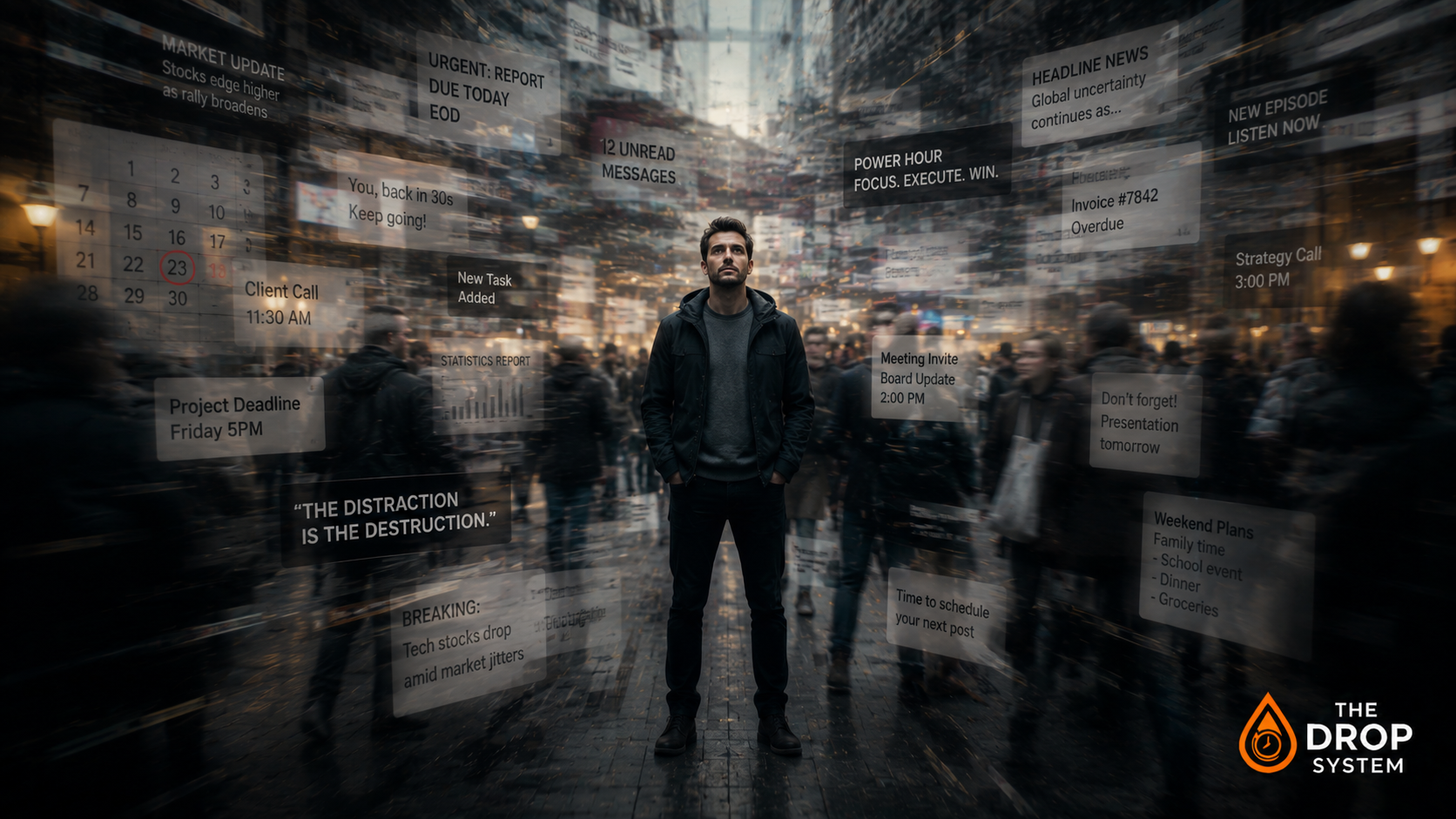
You don’t need to live next to a motorway to feel overwhelmed by noise.
In fact, some of the loudest noise in modern life cannot be heard at all.
It lives in your inbox.
Your notifications.
Your social feeds.
Your calendar.
Your to-do list.
Your group chats.
Your news alerts.
Your endless stream of things demanding attention.
Most people assume they are stressed because they have too much to do.
Sometimes that’s true.
But often the real problem is that they are carrying too much noise.
And noise isn’t just sound.
Noise is anything that competes for your attention.
Anything that fragments your thinking.
Anything that makes it harder to focus on what actually matters.
Which means many people are now living in the noisiest environment human beings have ever experienced.
No wonder so many of us feel exhausted.
We Were Never Designed For This Much Input
For most of human history, information arrived slowly.
News travelled slowly.
Communication happened slowly.
Decisions happened slowly.
You might hear a handful of important updates in a day.
Now you can receive more information before breakfast than your great-grandparents received in a week.
Think about that for a moment.
Before you’ve left the house, you may have already consumed:
- Emails
- WhatsApp messages
- News headlines
- Social media updates
- Weather forecasts
- Calendar reminders
- Marketing messages
- Work notifications
- Family group chats
And your day has barely started.
Your brain has not evolved at the same speed as technology.
The environment changed.
The wiring did not.
Information Is Not The Same As Knowledge
One of the biggest myths of the modern world is that more information automatically makes us better informed.
It doesn’t.
In fact, the opposite is often true.
When people are overwhelmed with information, they frequently struggle to identify what actually matters.
Everything starts competing equally for attention.
A breaking news story feels urgent.
A social media argument feels urgent.
An email feels urgent.
A notification feels urgent.
But urgency and importance are not the same thing.
And when your attention is constantly being pulled in different directions, everything starts feeling equally important.
That creates mental clutter.
And mental clutter creates stress.
The Cost Of Constant Awareness
Human beings were never meant to know everything happening everywhere all at once.
Yet many people now attempt exactly that.
Wars.
Politics.
Economic updates.
Celebrity drama.
Business news.
Industry gossip.
Viral videos.
Social media trends.
The latest outrage.
The latest crisis.
The latest thing you’re apparently supposed to care about.
There is nothing wrong with being informed.
The problem comes when awareness becomes endless.
Because awareness carries a cost.
Every piece of information demands a tiny amount of attention.
A tiny amount of emotional energy.
A tiny amount of processing power.
One item is insignificant.
Thousands are not.
Why Your Brain Never Feels Empty Anymore
Many people say the same thing:
“My brain never switches off.”
What they often mean is:
“My brain never stops processing.”
Because modern life leaves very little room for mental recovery.
The moment one input ends, another begins.
The podcast finishes.
The music starts.
The meeting ends.
The messages begin.
The television goes off.
The scrolling starts.
There is always something.
Always another input.
Always another demand.
Always another voice.
And eventually your mind starts feeling crowded.
Not because you’re failing.
Because you’re carrying far more than previous generations ever had to.
Silence Has Become Uncomfortable
This is one of the strangest side effects of modern life.
Many people now find silence uncomfortable.
Not because silence is bad.
Because silence is unfamiliar.
The moment things become quiet, many people instinctively reach for stimulation.
A phone.
A podcast.
A video.
A conversation.
Something.
Anything.
Because modern life has conditioned us to expect constant input.
Yet silence serves a purpose.
Silence creates space.
Space allows reflection.
Reflection creates clarity.
Clarity helps us make better decisions.
The problem is that clarity rarely arrives when your attention is being bombarded from every direction.
The Noise We Create Ourselves
Not all noise comes from technology.
Some of it comes from us.
We overcommit.
We say yes too often.
We collect responsibilities.
We create unnecessary complexity.
We fill every spare moment.
We convince ourselves that being busy means being productive.
Then we wonder why life feels overwhelming.
The truth is that some noise arrives from outside.
But some noise is self-inflicted.
And recognising the difference is important.
Because you can do something about the second category.
The DROP Lens: Reduce Noise Before Adding Structure
This is one of the reasons The DROP System works differently from many productivity systems.
Most productivity advice starts with planning.
DROP starts with clearing space.
The framework stands for:
Dump
Review
Offload
Plan
Notice the order.
You do not plan first.
You dump everything out of your head.
You review what actually matters.
You offload what shouldn’t be yours.
Then you plan.
Because adding structure to chaos still leaves you with chaos.
The goal is not becoming more efficient at managing noise.
The goal is reducing unnecessary noise in the first place.
Mid-Article Reality Check
You probably don’t need another productivity app.
You probably don’t need another planner.
You probably don’t need another colour-coded system.
What you might need is less.
Less input.
Less distraction.
Less clutter.
Less noise.
That sounds simple.
It isn’t.
Because modern life rewards accumulation.
More information.
More content.
More updates.
More notifications.
More commitments.
More everything.
The DROP Revolution exists because many people have reached the point where they no longer need more.
They need clarity.
If you’re ready to create more of that in your own life, you can Buy the book or Join the DROP System training.
How To Turn The Volume Down
You don’t need to disappear off-grid.
You don’t need to throw your phone away.
You don’t need to become a monk.
Start smaller.
Try:
- Turning off non-essential notifications
- Creating phone-free periods
- Limiting news consumption
- Scheduling communication windows
- Spending time without audio in the background
- Protecting uninterrupted thinking time
- Reducing unnecessary commitments
None of these changes are dramatic.
But together they create breathing room.
And breathing room is often where clarity lives.
What Happens When The Noise Drops
Something interesting happens when the noise begins to fade.
At first, it feels uncomfortable.
Then it feels unfamiliar.
Then, gradually, it starts feeling peaceful.
You think more clearly.
You focus more easily.
You become more present.
You make better decisions.
You stop reacting to everything.
You start noticing what actually matters.
And that is where real productivity begins.
Not with doing more.
But with creating enough space to do the right things well.
Summary
Modern life feels noisy because we are surrounded by more information, stimulation and demands than any previous generation has experienced.
The problem is not simply the volume of information.
It is the constant competition for attention.
That competition creates mental clutter, emotional fatigue and cognitive overload.
The answer is not avoiding technology completely.
The answer is becoming intentional about what deserves access to your attention.
If this article resonated with you, you may also want to read:
We No Longer Know How To Be Bored
Your Phone Is Training Your Attention Span
Why Your Brain Craves Constant Stimulation
The Psychological Cost Of Infinite Scroll
Together, they explain why so many people feel overwhelmed, distracted and mentally exhausted despite having more productivity tools than ever before.
And if you’re ready to cut through the noise and build a calmer, more intentional way of working and living, you can Buy the book or Join the DROP System training.
Leave a Reply