
If you’ve read a few productivity books already, this is a fair question.
Do you actually need another one?
Or are you just repeating the same cycle:
Read.
Feel motivated.
Change a few things.
Then drift back to old patterns.
There’s no shortage of books telling you how to work better, think clearer, or manage your time.
So before you add another one to the list, it’s worth being honest about what books can and can’t do.
Why this question matters
Most people don’t struggle with awareness.
They struggle with application.
You already know:
- You shouldn’t keep everything in your head
- You shouldn’t overcommit
- You should plan your week
- You should protect your time
Reading more doesn’t automatically change behaviour.
So the real question isn’t:
“Is this book good?”
It’s:
“Will this book actually change how I operate?”
When another productivity book won’t help
There are situations where buying another book is unlikely to move things forward.
1. You’re not applying what you already know
If you’ve read multiple books and haven’t implemented even one system properly, more input won’t fix that.
It will likely add to the noise.
You’ll recognise ideas.
You’ll agree with them.
You won’t change your behaviour.
That’s not a reading problem.
It’s an implementation gap.
2. You’re looking for a perfect method
Some people move from book to book searching for the system that finally “clicks”.
Something simpler.
Faster.
More complete.
That search can become a form of avoidance.
Because once you commit to a structure, you also commit to maintaining it.
And maintenance is where most people struggle.
3. You’re already overwhelmed
If your workload is already stretched, adding more ideas can feel like pressure.
Another framework to consider.
Another set of rules to follow.
In that state, what you usually need isn’t more information.
It’s less friction.
What books can do (and do well)
Used properly, a good book can create a shift.
Not because it gives you more tactics.
But because it changes how you think about the problem.
A strong framework can:
- Reframe how you see time and attention
- Challenge assumptions you didn’t realise you had
- Simplify complex behaviours into something usable
- Give language to things you’ve felt but not articulated
That matters.
Because clarity often precedes change.
What books cannot do
Books cannot install behaviour.
They can’t:
- Force consistency
- Reduce your workload
- Make decisions for you
- Replace structure
They also can’t adapt to your week in real time.
That’s where most people get stuck.
They expect the book to do the work.
Instead of using it as a guide for their own structure.
The difference between reading and using
There’s a simple distinction that gets missed.
Reading is passive.
Using is active.
If you read a book and move straight to the next one, you’re collecting ideas.
If you read a book and apply one part of it consistently for a month, you’re building behaviour.
The second approach is slower.
But it compounds.
A practical rule: one book, one action
If you do read another productivity book, use this rule.
Take one idea.
Not five.
Not ten.
One.
Apply it for 30 days.
For example:
- One capture system
- One weekly review habit
- One change to how you plan your days
If that one change sticks, you’ve extracted value.
If it doesn’t, you’ve learned something useful about your behaviour.
Either way, you move forward.
Where the DROP books fit into this
The three books currently available sit in slightly different places.
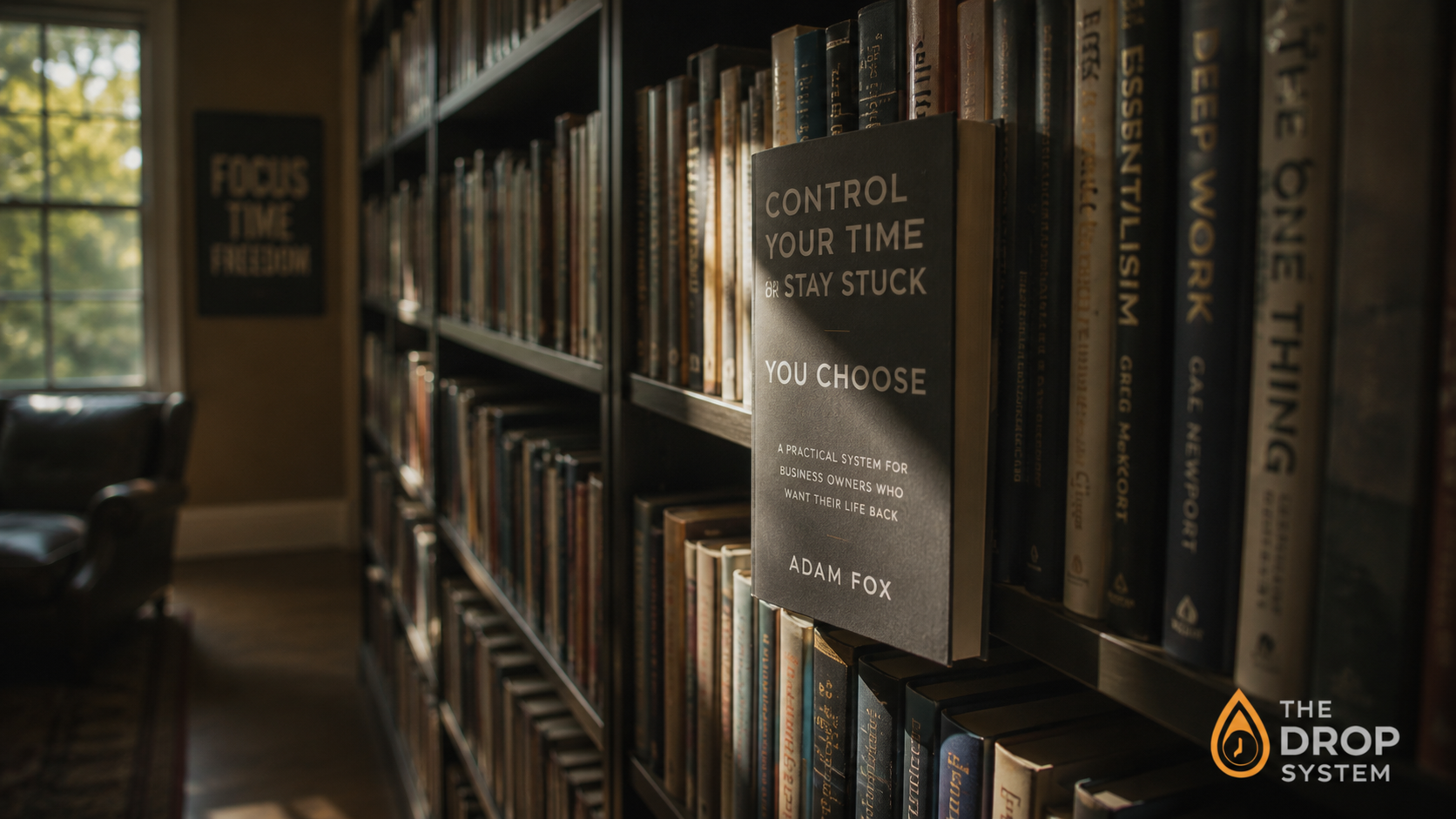
- Control Your Time or Stay Stuck focuses on practical structure and reclaiming control
- The Productivity Lie challenges common assumptions about productivity and performance
- The Man Who Collected Silence takes a different angle, exploring attention and stillness in a more reflective way
They are not designed to overwhelm you with tactics.
They are designed to change how you think about time, attention and behaviour.
That distinction matters.
Because behaviour change tends to follow clarity, not information volume.
What’s coming next (and why it matters)
There are also three additional books written and in development.
- Reclaim Your Attention
- Before They Are Hooked
- Your Brain is Amazing
These extend beyond traditional productivity.
They address the environment you’re operating in.
- Constant notifications
- Endless comparison
- Devices designed to pull attention
- Early exposure for children growing up in that world
For many people, productivity problems aren’t just about time.
They’re about attention.
And attention is being shaped long before adulthood.
That’s why the next phase of this work expands into that space.
Not to add complexity.
But to address a root cause that most productivity advice ignores.
The real question to ask yourself
Instead of asking:
“Do I need another productivity book?”
Ask:
“Am I willing to apply one idea properly?”
If the answer is no, another book won’t change much.
If the answer is yes, even one good framework can make a difference.
Summary
You don’t always need another productivity book.
Sometimes you need to use what you already know.
Books are useful when they:
- Change your perspective
- Simplify your thinking
- Give you a structure to apply
They are less useful when they:
- Add to existing overload
- Replace action with consumption
- Become a substitute for implementation
The value isn’t in reading more.
It’s in applying better.
If you want to explore the frameworks further
If you want to explore the books and choose one that fits where you are right now, you can browse the full collection here: