
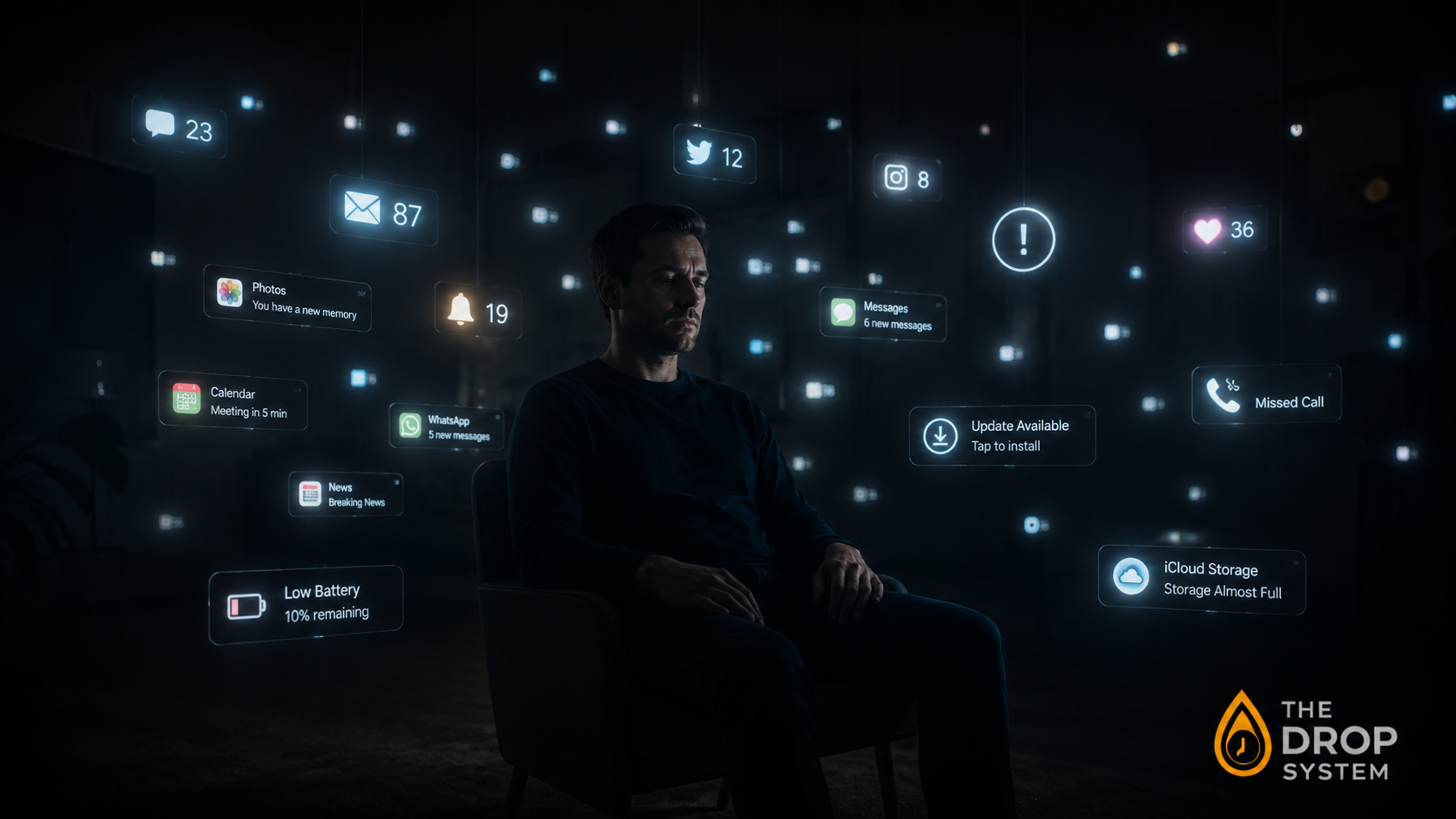
Most people think notifications are just interruptions.
Small distractions.
Minor annoyances.
Tiny breaks in concentration.
But over time, notifications do something much deeper than interrupt you.
They train you.
Not metaphorically.
Behaviourally.
Every vibration, alert, badge and pop-up teaches your brain to anticipate stimulation, shift attention rapidly and prioritise novelty over depth.
And once you understand that properly, it becomes much harder to see notifications as harmless background noise.
Why notifications feel impossible to ignore
Many people assume they lack discipline because they keep checking their phones.
But notifications are designed to trigger automatic behavioural responses.
They create:
- anticipation
- curiosity
- uncertainty
- social tension
- reward expectation
Your brain learns:
“Something important might have happened.”
That possibility alone is often enough to pull attention away from the present moment.
Even if the notification itself turns out to be meaningless.
The hidden mechanism: variable reward conditioning
This is where things become important.
Not every notification matters equally.
And that unpredictability is exactly what makes them powerful.
Sometimes:
- it’s a useful message
- it’s good news
- someone responds positively
- something exciting appears
Other times:
- it’s spam
- an irrelevant update
- meaningless noise
That inconsistency creates what behavioural psychology calls variable reward.
And variable reward is extremely habit-forming.
Because the brain starts chasing possibility, not value.
This is part of the reason many people now check their phones reflexively without consciously deciding to.
Why the brain starts craving interruption
Over time, constant notification exposure changes expectation.
Stillness starts feeling unfamiliar.
Single-tasking feels uncomfortable.
Silence feels empty.
Many people now experience low-level anticipatory behaviour throughout the day:
- checking phones without alerts
- refreshing apps automatically
- opening tabs instinctively
- reaching for stimulation during tiny moments of discomfort
Not because they consciously want distraction.
Because the brain has adapted to frequent reward opportunities.
The cost most people underestimate
Notifications don’t just consume seconds.
They fragment cognitive continuity.
Imagine writing something important.
You settle into focus.
Then:
- vibration
- glance
- micro-check
- quick reply
- return to task
The interruption itself may last ten seconds.
But mentally re-entering deep focus can take much longer.
Repeated across a day, this creates:
- reduced depth
- mental fatigue
- slower thinking
- more reactive behaviour
And eventually, many people stop experiencing uninterrupted concentration altogether.
If this is resonating, you’ve got three options.
You can carry on reading and let it sit as awareness.
You can explore the books on Amazon and start applying the framework in your own way.
Or, if you want structured support to actually install this properly and make it stick, you can join the training.
Join the DROP online training
Notifications create environmental anxiety
Even when ignored, notifications affect attention.
Many people now work with:
- banners appearing constantly
- unread counts visible
- devices within arm’s reach
- multiple communication channels active simultaneously
That creates low-level cognitive vigilance.
Part of the brain remains alert to possible interruption.
Which means part of your attention is never fully allocated to the task in front of you.
This is one reason people increasingly feel:
- mentally stretched
- cognitively thin
- unable to settle properly into work or rest
Their attention is permanently semi-open.
A realistic modern example
Think about how often this happens:
You pick up your phone to check one message.
Twenty minutes later you’re:
- watching something unrelated
- replying to another conversation
- checking headlines
- scrolling without intention
Then you put the phone down and wonder where the time went.
That’s not purely lack of discipline.
It’s behavioural momentum.
Notifications open attention loops.
Platforms then compete to keep those loops open for as long as possible.
The DROP lens: reduce access points to your attention
This is where attention protection becomes practical.
Most people try to improve focus while leaving every interruption channel fully open.
That rarely works long term.
The goal is not becoming anti-technology.
The goal is reducing unnecessary access points to your attention.
That may mean:
- disabling non-essential notifications
- removing badges
- placing devices physically elsewhere
- batching communication windows
- creating uninterrupted focus periods
Not because notifications are evil.
Because uninterrupted attention is increasingly valuable.
What will feel uncomfortable
Reducing notifications often creates withdrawal-like discomfort initially.
People notice:
- urges to check devices
- phantom vibrations
- anxiety about missing something
- boredom during quiet moments
That discomfort is useful information.
It reveals how conditioned the behaviour has become.
Most people assume they are making conscious choices online far more often than they actually are.
Why this matters beyond productivity
This affects more than work output.
It shapes:
- emotional regulation
- patience
- presence
- relationships
- sleep quality
- creativity
- depth of thought
If attention is repeatedly interrupted all day, the nervous system rarely settles fully.
And many people now live inside that state permanently without recognising it.
Calm summary
Notifications are not just interruptions.
They are behavioural training systems.
Over time they condition:
- rapid attention switching
- novelty seeking
- anticipatory checking
- reduced tolerance for stillness
This is not about becoming extreme or rejecting technology completely.
It’s about understanding the environment your brain is adapting to.
Because once you understand the conditioning, you can start deciding which behaviours you actually want to reinforce.
If you want to explore this work further
These ideas sit inside the wider body of work around attention, distraction and modern life.
You can explore more essays and long-form thinking at adamfoxofficial.com
Or go deeper into the books exploring attention, behaviour and modern environments by choosing a starting point on Amazon