
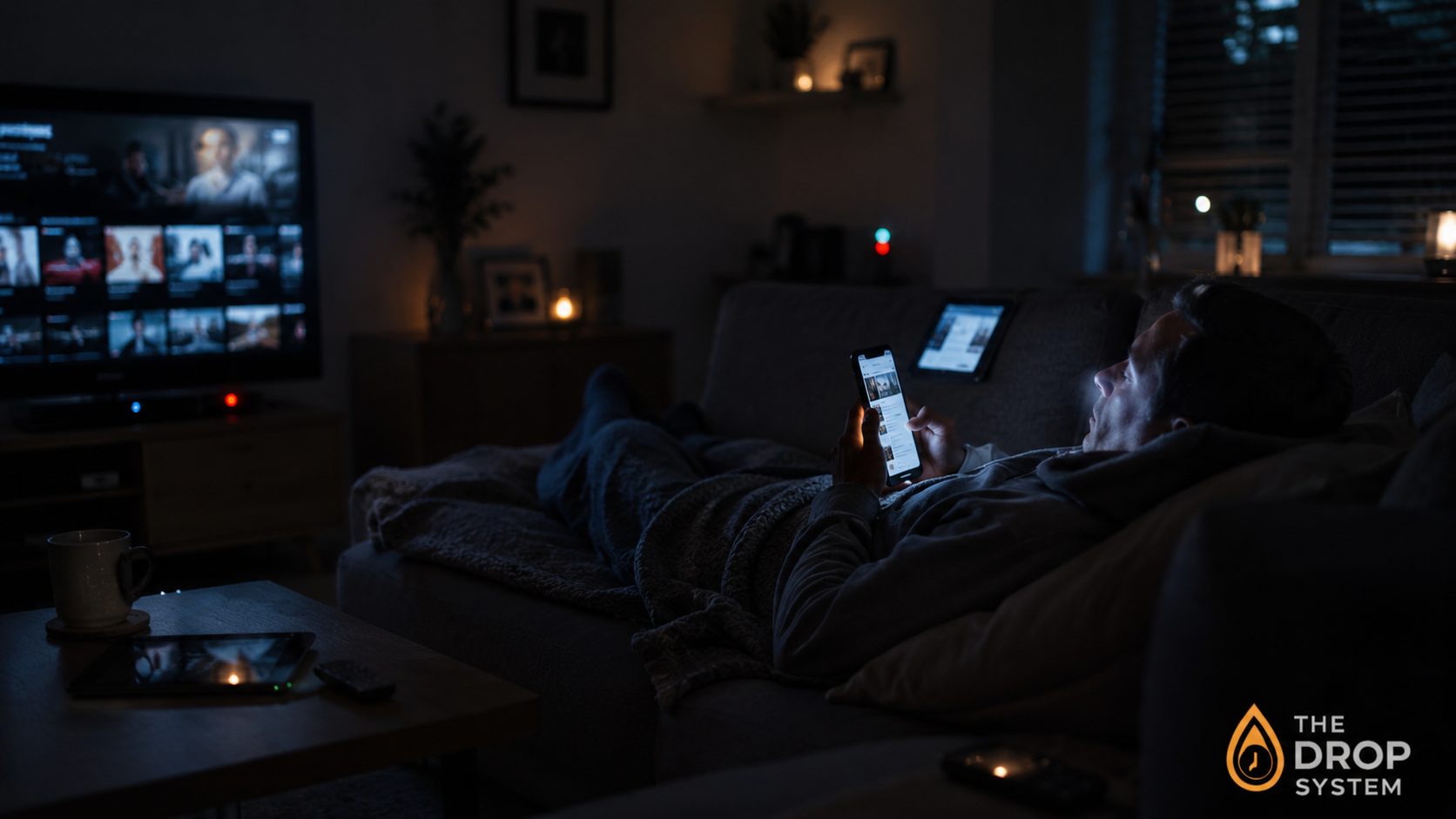
A lot of people are technically resting.
They sit down.
They stop working.
They watch something.
They scroll for a bit.
They “switch off”.
And yet they still feel mentally tired afterwards.
Not fully restored.
Not properly calm.
Just slightly less active.
That distinction matters.
Because for many people now, rest has quietly become another form of stimulation.
Why this feels confusing
Most people assume exhaustion comes purely from working too much.
Sometimes it does.
But increasingly, people are becoming cognitively overloaded even when they are physically inactive.
You can spend an entire evening on the sofa and still wake up mentally drained the next morning.
Why?
Because the brain hasn’t actually disengaged.
It has simply switched stimulation sources.
The hidden mechanism: constant cognitive input
For many people, the modern day looks something like this:
- work notifications
- emails
- conversations
- tabs
- alerts
- background noise
- social media
- streaming content
- podcasts
- headlines
- messages
Input continues almost constantly.
Even “rest” often includes:
- scrolling
- second-screen viewing
- passive consumption
- endless recommendation feeds
The brain rarely experiences genuine cognitive quiet anymore.
And without cognitive quiet, recovery becomes difficult.
Rest and stimulation are not the same thing
This is where the confusion usually sits.
Relaxation is not always recovery.
Something can feel easy while still demanding attention.
For example:
- endless scrolling
- autoplay video
- rapid short-form content
- low-level browsing
These activities may feel restful compared to work.
But they still involve:
- switching attention
- processing novelty
- emotional reactions
- anticipatory behaviour
- cognitive engagement
That’s not the same as mental stillness.
Why silence feels uncomfortable now
Many people now struggle with:
- quiet walks without headphones
- sitting without checking a device
- reading slowly
- eating without stimulation
- being alone with their thoughts
Not because they are incapable.
Because the brain adapts to baseline stimulation levels.
When constant input becomes normal, silence initially feels unfamiliar.
Sometimes even uncomfortable.
This is one reason many people reach for their phones automatically during tiny gaps:
- queues
- lifts
- waiting rooms
- adverts
- pauses in conversation
The nervous system becomes conditioned against stillness.
If this is resonating, you’ve got three options.
You can carry on reading and let it sit as awareness.
You can explore the books on Amazon and start applying the framework in your own way.
Or, if you want structured support to actually install this properly and make it stick, you can join the training.
Join the DROP online training
The cost of never fully disengaging
When the brain remains continuously stimulated, people often notice:
- lower patience
- mental fog
- irritability
- emotional flatness
- reduced creativity
- difficulty concentrating deeply
- poorer sleep quality
This is not always dramatic.
It’s often subtle.
But subtle chronic overload accumulates.
And many people now live inside low-level cognitive exhaustion so consistently that they assume it is normal adulthood.
It isn’t necessarily normal.
It’s environmental.
Why “doing nothing” feels harder than it should
Many people say:
“I can’t switch off.”
Usually what they mean is:
“I no longer know how to tolerate under-stimulation.”
That sounds harsh, but it’s important.
Modern environments train the brain toward constant engagement.
So when stimulation drops:
- boredom appears quickly
- discomfort rises
- urges to check devices emerge
That does not mean your brain is broken.
It means it has adapted.
And adaptation can be reversed.
The DROP lens: recovery is now a structural issue
This is bigger than productivity.
You cannot sustain:
- deep focus
- emotional regulation
- good decision-making
- creativity
- presence
…without genuine recovery.
And genuine recovery increasingly requires:
- reduced input
- reduced switching
- reduced engagement demand
Not just “time off”.
Because time off filled with endless stimulation is not always restorative.
A realistic example
Imagine two evenings.
Evening one
- TV on
- scrolling simultaneously
- checking messages
- browsing headlines
- responding to notifications
- background YouTube running
Technically relaxing.
But cognitively busy.
Evening two
- phone elsewhere
- quiet walk
- uninterrupted reading
- conversation without devices
- no constant switching
Less stimulation.
More recovery.
The second evening may initially feel slower.
But many people notice they sleep differently afterwards.
Calmer. Heavier. More settled.
That is not accidental.
What will feel uncomfortable
Reducing stimulation often feels strange before it feels restorative.
You may notice:
- boredom
- restlessness
- urges to consume content
- discomfort during silence
That discomfort is useful information.
It reveals how accustomed the nervous system has become to continuous engagement.
Most people are not addicted to work itself.
They are addicted to stimulation patterns.
Why this matters long term
Without proper recovery:
- focus deteriorates
- stress tolerance lowers
- emotional regulation weakens
- attention fragments faster
Eventually, people try solving exhaustion with:
- more productivity systems
- stricter routines
- more optimisation
When the real issue is that the nervous system never fully powers down.
That changes the solution completely.
Calm summary
Many people are resting physically but remaining cognitively active all day.
That is why rest often no longer feels restorative.
Constant stimulation:
- fragments attention
- prevents nervous system recovery
- reduces tolerance for stillness
- creates low-level mental exhaustion
The answer is not removing technology entirely.
It’s understanding the difference between:
stimulation and restoration.
Because they are not the same thing.
If you want to explore this work further
These ideas connect deeply into the wider work around attention, modern life and cognitive recovery.
You can explore more essays and long-form thinking at adamfoxofficial.com
Or explore the books on Amazon to go deeper into the relationship between attention, behaviour and modern environments.