
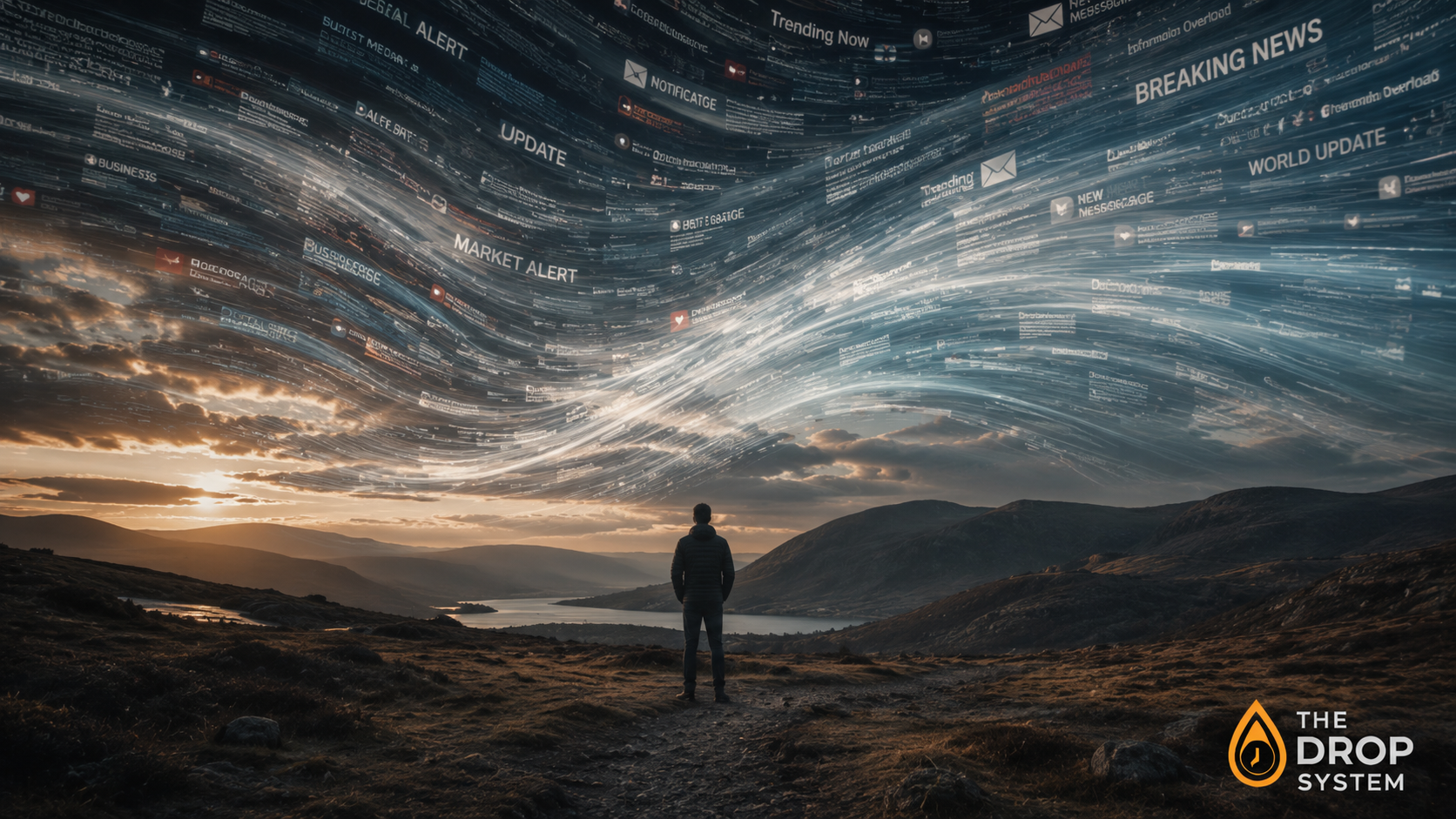
For most of human history, the human brain dealt with relatively limited streams of information.
Conversations.
Weather.
Immediate threats.
Community dynamics.
Physical environments.
Now compare that to a normal Tuesday morning.
Before many people even leave the house, they have already processed:
- messages
- headlines
- notifications
- emails
- short-form video
- recommendations
- adverts
- opinions
- alerts
- algorithmic content
The volume is unprecedented.
And while technology has evolved rapidly, the human brain has not evolved at the same speed.
That mismatch matters more than most people realise.
Why modern life feels mentally heavy
A lot of people assume they are struggling because they are weak, distracted or undisciplined.
But many are simply cognitively overloaded.
The brain is constantly:
- filtering
- prioritising
- switching
- reacting
- anticipating
- suppressing distractions
Even when you feel like you are “doing nothing”, your attention may still be processing huge amounts of information.
That creates fatigue.
Not because the brain is failing.
Because it is working exactly as designed inside conditions it was never designed for.
The hidden mechanism: evolutionary mismatch
Human biology changes slowly.
Technology changes extremely quickly.
That creates what psychologists and behavioural scientists often refer to as evolutionary mismatch.
In simple terms:
The environment changed faster than the brain could adapt.
Your nervous system evolved for:
- intermittent stimulation
- periods of quiet
- slower information flow
- smaller social circles
- physical-world threats
Modern life delivers:
- endless novelty
- constant interruption
- global comparison
- rapid context switching
- unlimited information access
- perpetual stimulation
The result is not necessarily breakdown.
But it is overload.
Why your attention feels stretched thin
The brain prioritises novelty naturally.
New information might once have signalled:
- opportunity
- danger
- food
- social importance
That survival wiring still exists.
Which means modern digital environments repeatedly trigger attentional responses designed for entirely different contexts.
Every:
- alert
- refresh
- new post
- recommendation
- message
…pulls on ancient systems using modern technology.
This is one reason people often feel mentally exhausted despite not performing physically demanding work.
Their attention systems are under continuous demand.
If this is resonating, you’ve got three options.
You can carry on reading and let it sit as awareness.
You can explore the books on Amazon and start applying the framework in your own way.
Or, if you want structured support to actually install this properly and make it stick, you can join the training.
Join the DROP online training
Why constant input changes behaviour
Many people now struggle with:
- reading deeply
- sitting still
- tolerating boredom
- maintaining concentration
- finishing tasks without checking something
Not because they are incapable.
Because the brain adapts to repeated conditions.
If you repeatedly expose attention systems to:
- rapid novelty
- short-form stimulation
- constant interruption
…the brain gradually becomes more accustomed to fragmentation.
Depth starts feeling harder.
Not impossible.
Just less familiar.
The modern brain rarely gets recovery space
This is important.
Historically, the brain experienced natural pauses.
Walking.
Waiting.
Quiet evenings.
Physical labour without constant input.
Moments of reflection.
Today, many gaps are immediately filled.
Queues become scrolling time.
Waiting becomes checking time.
Silence becomes podcast time.
Walking becomes content consumption time.
The nervous system rarely experiences under-stimulation anymore.
And under-stimulation is often where recovery, reflection and deeper thinking happen.
A realistic example
Imagine trying to read a book for one uninterrupted hour.
For many people, this now feels surprisingly difficult.
Not because reading is harder.
Because the brain has become adapted to higher stimulation frequency.
When reading:
- there are no alerts
- no instant novelty
- no rapid reward loops
So attention begins searching for stimulation elsewhere.
This is why many people:
- reread paragraphs repeatedly
- check phones mid-page
- struggle to sustain focus
Again, not weakness.
Conditioning.
The DROP lens: reduce cognitive competition
Traditional productivity advice usually focuses on:
- planning better
- managing time
- improving discipline
But increasingly, the real issue is environmental competition for attention.
You cannot consistently think deeply while your brain is competing against:
- notifications
- novelty loops
- algorithmic stimulation
- constant switching demands
That changes the conversation entirely.
The goal becomes:
creating environments where depth can survive.
Not simply forcing yourself to “try harder”.
What will feel uncomfortable
Reducing input often initially feels:
- boring
- slow
- empty
- restless
Many people become uncomfortable very quickly without stimulation.
That discomfort is not proof you need more input.
It is often proof of how accustomed the nervous system has become to constant engagement.
And importantly:
that conditioning can soften over time.
Why this matters for children as well
Children growing up now are entering these environments far earlier than previous generations.
That means:
- less uninterrupted boredom
- more algorithmic stimulation
- earlier reward conditioning
- shorter default attention windows
This is one reason the wider body of work is now expanding into parenting and childhood attention development.
Because attention patterns are increasingly shaped long before adulthood.
And many parents sense this intuitively, even if they struggle to articulate it fully.
Summary
Your brain was not built for endless input.
It evolved for:
- slower information flow
- intermittent stimulation
- quieter environments
- fewer competing demands
Modern life delivers the opposite.
That does not mean technology is inherently bad.
But it does mean many people are cognitively overloaded without fully recognising why.
Understanding that changes the goal.
The goal is no longer:
“Become perfectly disciplined.”
It becomes:
“Protect attention inside an environment designed to fragment it.”
If you want to explore this work further
These ideas connect deeply into the wider essays and long-form work around attention, distraction and modern life.
You can explore more at adamfoxofficial.com
Or explore the wider collection of books on Amazon