
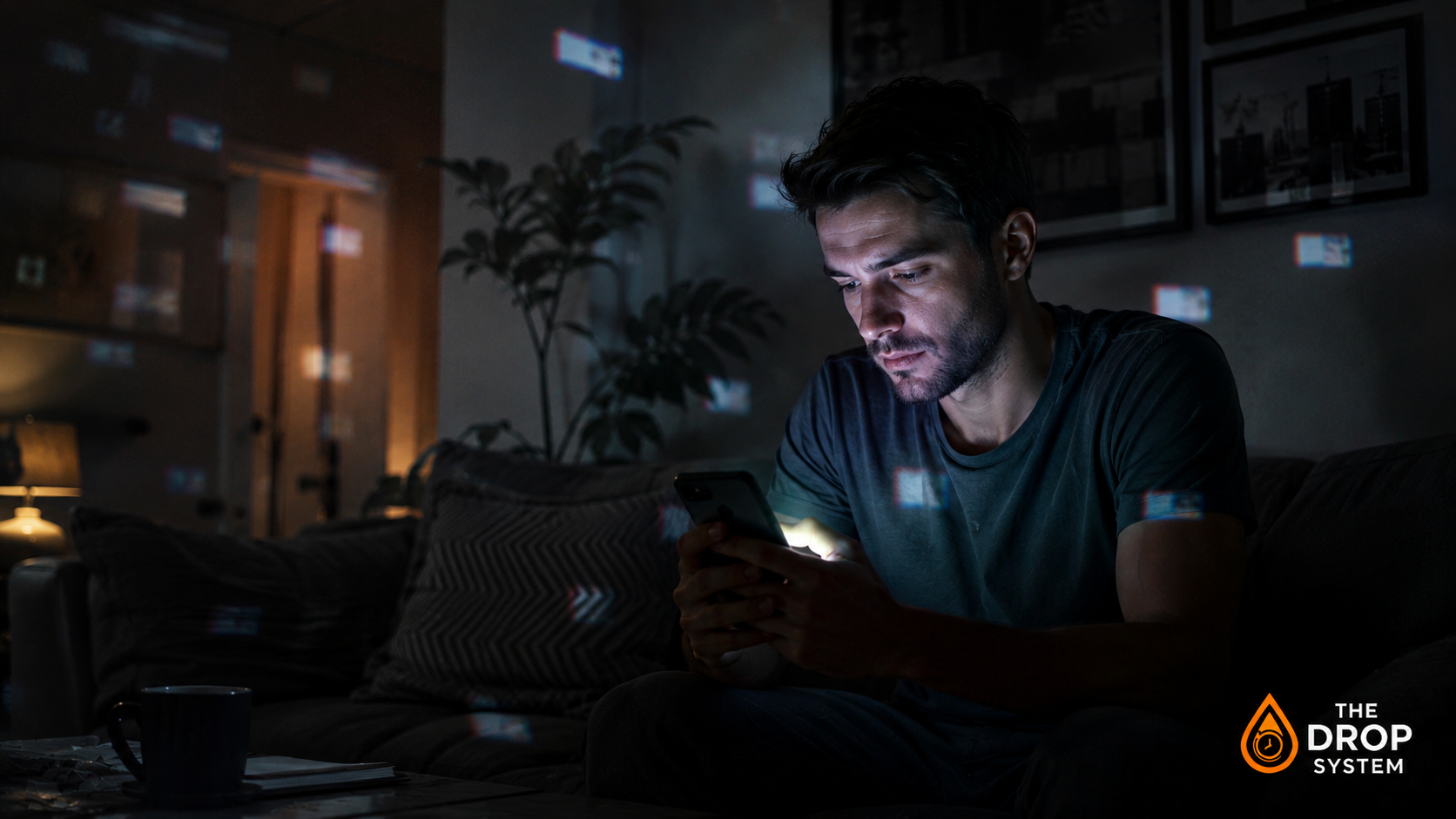
Most people think their phone is just a tool.
A communication device.
A bit of entertainment.
Something useful to have nearby.
But modern phones do something far more powerful than most people realise.
They train behaviour.
Quietly.
Repeatedly.
Constantly.
Every notification, vibration, badge icon, swipe, refresh and short-form hit of novelty teaches your brain something.
Check again.
Look again.
Stay alert.
Do not disconnect for too long.
And over time, your attention span adapts around that environment.
That is why so many people now struggle to focus on slower tasks.
Reading feels harder.
Thinking deeply feels harder.
Long conversations feel harder.
Single-tasking feels harder.
Not because people suddenly became lazy.
Because their attention is being conditioned by the environments they spend time in every day.
Your Brain Adapts to Whatever You Repeatedly Feed It
The brain is incredibly adaptable.
That is one of its greatest strengths.
But it also means repeated behaviours shape expectation.
If your brain gets used to rapid stimulation, rapid switching and constant novelty, slower forms of attention start feeling unfamiliar.
That is not philosophy.
That is conditioning.
And phones are very good at creating conditioning loops.
You check your phone.
You find something mildly rewarding.
A message.
A like.
A notification.
A video.
A news update.
Your brain gets a tiny dopamine response linked to novelty and anticipation.
So you check again later.
And again.
And again.
Eventually, the behaviour becomes automatic.
Not because you consciously decided to use your phone 200 times a day.
Because repetition turned it into habit.
Many people now reach for their phone before they are even fully awake.
Not intentionally.
Automatically.
That should probably tell us something.
Why Your Attention Span Feels Worse Than It Used To
Attention works a bit like physical fitness.
The environment you repeatedly operate in shapes your capacity.
If you spend years training your attention around:
- short bursts of novelty
- rapid switching
- constant interruption
- low-friction stimulation
- endless scrolling
- fragmented focus
then sustained attention naturally becomes harder.
Again, that does not mean impossible.
But harder.
This is one reason people often say things like:
“I cannot focus like I used to.”
“My brain feels scattered.”
“I keep picking my phone up without thinking.”
“I struggle to finish books now.”
“I cannot sit through a film without checking my phone.”
Those are not random isolated behaviours.
They are connected.
Your phone is not just consuming your attention.
It is shaping how your attention operates.
Notifications Are Not Neutral
Most people underestimate how disruptive notifications actually are.
Because individually they seem harmless.
One vibration.
One banner.
One sound.
One quick glance.
But interruptions have a cognitive cost.
Even small ones.
Research around attention residue shows that when attention switches tasks, part of the brain remains mentally attached to the previous activity.
That means your brain does not instantly reset every time you glance at your phone.
A little bit of attention stays behind.
Multiply that across dozens or hundreds of interruptions per day and you create constant cognitive fragmentation.
That is exhausting.
Not dramatic exhaustion.
Mental exhaustion.
The kind where your brain feels noisy all day long.
The kind where you technically rested but still feel mentally overloaded.
The kind where deep focus starts feeling increasingly rare.
The Real Problem Is Not Discipline
This is important.
The answer is not pretending people simply need “more discipline”.
That is lazy analysis.
Modern phones are designed by teams of behavioural scientists, UX specialists and attention engineers whose job is literally to increase engagement.
Infinite scroll was not accidental.
Push notifications were not accidental.
Read receipts were not accidental.
Variable reward systems were not accidental.
These platforms compete for attention because attention generates money.
That is the business model.
So when people struggle to disconnect, that is not purely an individual weakness.
It is also an environmental issue.
And blaming yourself constantly usually just creates shame without creating awareness.
Awareness is more useful.
Because once you understand what is happening, you can start changing your relationship with it.
What This Looks Like in Real Life
You unlock your phone to check one message.
Twenty minutes disappear.
You open Instagram for “a minute”.
You forget why you picked the phone up in the first place.
You sit down to work and immediately feel the urge to check notifications.
You watch television while simultaneously scrolling another screen.
You feel phantom vibrations that never happened.
You struggle to get through a chapter of a book without reaching for your device.
You check your phone during conversations without even meaning to.
None of this makes you a bad person.
But it does show how deeply integrated these habits have become.
And the more automatic they become, the more they shape your attention baseline.
Your Phone Is Filling Every Tiny Gap
One of the biggest shifts in modern life is that almost no gaps remain unfilled anymore.
Waiting for the kettle?
Phone.
Standing in a queue?
Phone.
Walking somewhere?
Phone.
Sitting in silence?
Phone.
In the car?
Podcast.
At the gym?
Video.
On the sofa?
Second screen.
Many people now move from one stream of input to another from the moment they wake up until the moment they sleep.
That leaves very little room for mental recovery.
Or reflection.
Or boredom.
Or uninterrupted thought.
This is one reason so many people say their brain feels permanently busy now.
It is busy.
Not always with meaningful thinking.
But with continuous input.
If this feels familiar, you may also want to read [link to: “What Your First 30 Days With DROP Actually Look Like”].
The DROP Lens: Protecting Attention Instead of Chasing Productivity
The DROP System stands for:
Dump
Review
Offload
Plan
And while most people initially discover DROP through productivity, the deeper layer underneath it is attention protection.
Because productivity without attention is chaos.
You cannot prioritise clearly if your brain is overstimulated.
You cannot think deeply if you are constantly interrupted.
You cannot plan effectively if your nervous system never slows down.
That is why DROP works differently to many traditional productivity systems.
It is not built around squeezing more output from exhausted people.
It is built around reducing cognitive overload first.
That matters.
Because modern life already provides more input than most human brains were designed to process continuously.
The answer is not endlessly optimising harder.
Sometimes the answer is reducing noise.
Mid-Article Reality Check
Most people are not struggling because they are incapable of focus.
They are struggling because their attention is being fragmented hundreds of times per day.
That changes how the brain operates.
And if you never step back and notice it happening, the behaviour eventually feels normal.
That is exactly why The DROP Revolution exists.
Not to shame technology.
Not to tell people to live in a cabin in the woods.
But to help people take back control of their attention before distraction becomes their permanent operating system.
If you want structured support applying this properly, you can Join the DROP System training.
Or if you want the full framework in book form, you can Buy the book.
Why Children Are Especially Vulnerable
Adults at least remember a world before smartphones.
Children often do not.
That changes the equation completely.
Many children are now growing up inside environments where constant stimulation is normal from the very beginning.
Fast edits.
Rapid novelty.
Endless scrolling.
Continuous entertainment.
That does not just affect behaviour.
It affects developmental expectations around attention itself.
Because if a child becomes used to extremely high stimulation environments, slower activities naturally feel harder by comparison.
Reading.
Homework.
Stillness.
Reflection.
Patience.
Long-form thinking.
Again, this is not about blaming parents.
Modern parenting is brutally hard.
Everyone is tired.
Everyone is overloaded.
Screens are often the thing that buys breathing room.
But it is still important to recognise the wider attention environment children are growing up inside.
Because phones are not passive objects anymore.
They are behavioural ecosystems.
How To Start Reclaiming Your Attention
You do not need to throw your phone away.
Most people could not realistically do that even if they wanted to.
The goal is not elimination.
The goal is awareness and control.
Start with small changes.
Try:
- disabling non-essential notifications
- leaving your phone in another room during deep work
- creating phone-free meals
- removing social apps from your home screen
- stopping endless background noise
- going for short walks without audio
- reading for ten minutes without checking your device
- charging your phone outside the bedroom
None of these changes are dramatic.
That is why they work better long term.
Small consistent reductions in cognitive noise matter more than short extreme detoxes most people abandon within a week.
The Bigger Question Nobody Asks
The deeper issue underneath all this is not really about phones.
It is about agency.
Who controls your attention?
You?
Or the systems competing for it?
Because attention shapes experience.
What you repeatedly pay attention to gradually becomes your mental environment.
And if your attention is constantly reactive, fragmented and externally directed, eventually your life starts feeling that way too.
That is why protecting attention is becoming one of the most important modern skills.
Not because it sounds productive.
Because it affects:
- clarity
- emotional regulation
- presence
- relationships
- creativity
- recovery
- mental health
- decision-making
Phones are not inherently evil.
But unconscious use absolutely has consequences.
Summary
Your phone is not just distracting you.
It is training your attention span.
Repeated exposure to rapid novelty, interruptions and constant stimulation changes how attention operates over time.
That is why slower forms of focus increasingly feel difficult for many people.
The solution is not panic.
And it is not abandoning technology completely.
It is becoming more intentional about how much access distraction has to your attention every day.
Because if you do not deliberately protect your attention, something else will happily consume it for you.
If this resonated, you may also want to read:
“What Your First 30 Days With DROP Actually Look Like”
And if you want deeper support applying these ideas in real life, you can Buy the book ; or Join the DROP System training.