
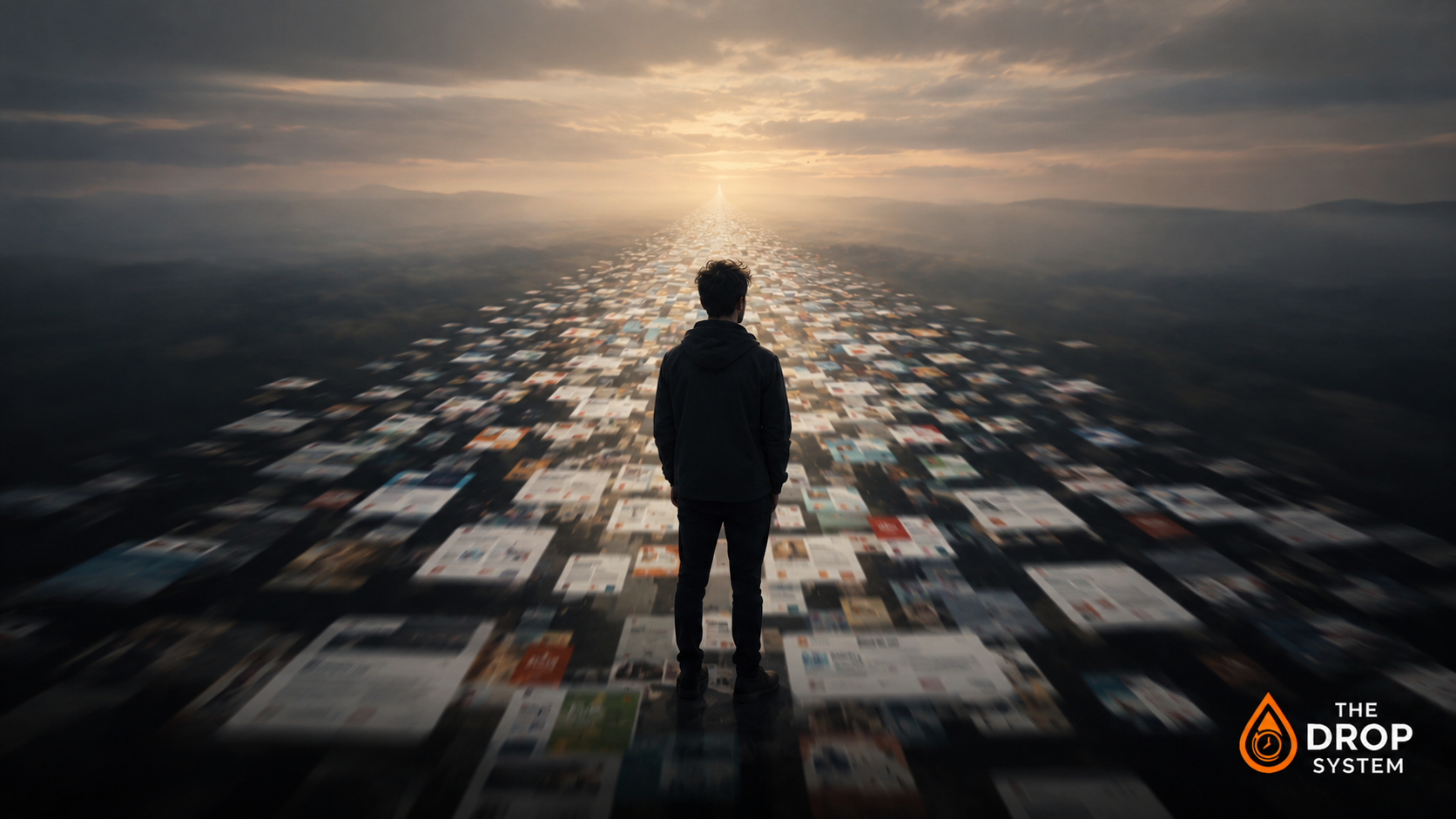
Most people think scrolling is harmless.
A few minutes here.
A quick check there.
Something to fill a gap while waiting for the kettle to boil.
Something to do while watching television.
Something to pass the time before bed.
It feels insignificant.
Which is exactly why it is so dangerous.
Because the biggest costs of infinite scroll rarely show up immediately.
You do not finish a scrolling session and suddenly lose your job.
You do not destroy a relationship with a single scroll.
You do not wake up one morning and realise social media stole your attention overnight.
The cost is gradual.
Tiny deposits made day after day.
Month after month.
Year after year.
Until one day you find yourself struggling to focus, struggling to be present, struggling to sit still, and wondering why your brain feels permanently busy.
The problem was never one scroll.
The problem was the accumulation of thousands of them.
Infinite Scroll Was Never Designed to Help You
Let’s start with something important.
Infinite scroll was not created to improve your life.
It was not designed to help you focus.
It was not built to increase your wellbeing.
It was built to keep you engaged.
That’s it.
The longer you stay on a platform, the more attention you give it.
The more attention you give it, the more valuable you become.
Infinite scroll removed a natural stopping point.
That matters more than most people realise.
Think about a magazine.
A newspaper.
Even a book.
Eventually you reach the end.
Your brain gets a cue that says:
“That’s enough for now.”
Infinite scroll removed that cue.
There is always another post.
Another video.
Another story.
Another opinion.
Another piece of content.
The stream never ends.
And when something never ends, your brain finds it surprisingly difficult to stop.
The Hidden Mental Load Nobody Talks About
One of the biggest psychological costs of infinite scroll is cognitive clutter.
Every post you consume takes up a tiny amount of mental bandwidth.
A news story.
A political opinion.
A fitness tip.
A celebrity scandal.
A business update.
A funny video.
A parenting debate.
A motivational quote.
Individually they seem insignificant.
Collectively they create noise.
The problem is that your brain does not simply switch off when you stop scrolling.
Fragments remain.
Thoughts linger.
Opinions bounce around.
Emotions stay active.
Questions remain unresolved.
And eventually your mind starts to feel crowded.
Not because you have too much to do.
But because you have taken in far more information than your brain has had time to process.
Why Scrolling Rarely Feels Satisfying
Have you ever noticed how rarely people finish scrolling and think:
“That was time well spent.”
Most people stop because:
- they feel guilty
- they get interrupted
- they become tired
- their battery dies
- they force themselves to stop
Very few people reach a natural point of satisfaction.
That is because infinite scroll is designed around consumption rather than completion.
Completion feels good.
Finishing a project feels good.
Finishing a book feels good.
Finishing a workout feels good.
There is a sense of progress.
A sense of achievement.
A sense of closure.
Infinite scroll offers none of those things.
You consume.
And consume.
And consume.
Without ever really arriving anywhere.
Which is one reason so many people finish long scrolling sessions feeling oddly empty.
Comparison Is Now Constant
Human beings have always compared themselves to others.
Social media did not invent comparison.
It industrialised it.
Previous generations compared themselves to:
- neighbours
- colleagues
- friends
- family
Today’s average person compares themselves to hundreds or thousands of people every week.
Business owners compare themselves to bigger businesses.
Parents compare themselves to perfect families.
Fitness enthusiasts compare themselves to athletes.
Teenagers compare themselves to influencers.
Everyone compares themselves to someone.
And because social media tends to show highlight reels rather than reality, the comparison is often distorted from the beginning.
You are comparing your behind-the-scenes reality to somebody else’s edited showcase.
That creates pressure.
Even when you don’t consciously realise it.
Why Your Mood Can Change Without You Noticing
One of the strangest effects of scrolling is how it influences emotions without obvious awareness.
You open an app feeling perfectly fine.
Twenty minutes later you feel:
- irritated
- anxious
- inadequate
- frustrated
- distracted
- restless
Yet nothing actually happened to you.
No argument.
No crisis.
No major event.
Just exposure to hundreds of small emotional triggers.
A worrying headline.
A negative comment.
A political argument.
Someone else’s success.
Somebody else’s holiday.
Somebody else’s body.
Somebody else’s house.
Your brain absorbs all of it.
Not equally.
Not consciously.
But enough for it to affect your emotional state.
That is one of the reasons many people feel mentally drained after scrolling.
They have been processing far more emotional information than they realise.
The Cost to Focus Is Enormous
The longer you spend consuming rapidly changing information, the harder it becomes to maintain sustained attention.
That is not because your brain is broken.
It is because your brain adapts.
Scrolling trains attention to:
- switch quickly
- scan rapidly
- seek novelty
- avoid stillness
- move on immediately
Deep focus requires the opposite.
Patience.
Sustained attention.
Single-tasking.
Mental endurance.
The more time spent in one mode, the harder it can feel to operate in the other.
This is one reason so many people report:
“I can’t read books like I used to.”
“I struggle to focus.”
“My attention span feels awful.”
“I keep reaching for my phone.”
The behaviours are connected.
The Real Cost Is Presence
The biggest cost of infinite scroll is not productivity.
It is presence.
Because attention determines experience.
You cannot be fully present with your partner while mentally checking your phone.
You cannot be fully present with your children while scrolling through content.
You cannot be fully present with your own thoughts if every spare second is filled with input.
And presence is where most of life actually happens.
Conversations.
Relationships.
Experiences.
Memories.
Meaning.
These things require attention.
When attention is elsewhere, life often feels thinner.
Not because life changed.
Because your attention did.
The DROP Lens: Consuming Less, Living More
The DROP System stands for:
Dump
Review
Offload
Plan
Most people assume productivity begins with planning.
It doesn’t.
It begins with reducing noise.
Because overwhelmed brains make poor decisions.
Infinite scroll creates noise.
Mental noise.
Emotional noise.
Cognitive noise.
The goal is not to eliminate social media completely.
The goal is becoming conscious of how much of your attention is being consumed by things that add little value to your life.
That awareness alone changes behaviour.
Because once you start seeing the cost clearly, endless scrolling becomes far less appealing.
Mid-Article Reality Check
This article is not arguing that social media is evil.
Nor is it suggesting that every minute spent online is wasted.
The issue is unconscious consumption.
Most people do not decide to spend an hour scrolling.
They lose an hour scrolling.
That difference matters.
Because intentional behaviour feels very different from automatic behaviour.
The goal is not perfection.
The goal is awareness.
That is exactly what The DROP Revolution is about.
Helping people reclaim attention, clarity and control in a world designed to fragment all three.
If you want practical tools to help you do that, you can Explore the books or Join the DROP System training.
How To Break The Infinite Scroll Habit
Most people fail because they try to quit completely.
That rarely works.
Instead, start by increasing awareness.
Try:
- removing social media apps from your home screen
- disabling non-essential notifications
- setting intentional times to check platforms
- keeping your phone out of reach during focused work
- replacing some scrolling time with reading or walking
- tracking how often you actually pick up your phone
The goal is not becoming perfect.
The goal is reducing unconscious behaviour.
Small improvements compound surprisingly quickly.
The Bigger Question
Imagine getting to the end of this year.
How many hours will you have spent scrolling?
Not intentionally learning.
Not communicating with people you care about.
Not creating.
Just consuming.
Now imagine reinvesting even half of those hours into:
- family
- fitness
- reading
- learning
- business
- hobbies
- relationships
- rest
The difference would be enormous.
That is why infinite scroll matters.
Not because every minute is harmful.
Because the cumulative effect is far bigger than most people realise.
Summary
Infinite scroll seems harmless because each individual session feels insignificant.
But the psychological costs add up.
Reduced focus.
Increased comparison.
Mental clutter.
Emotional fatigue.
Lower presence.
Fragmented attention.
The issue is not technology itself.
The issue is unconscious consumption.
Because attention is one of the most valuable resources you possess.
And every minute spent scrolling is a minute that cannot be spent anywhere else.
The question is not whether infinite scroll affects you.
The question is whether you are consciously deciding how much of your life you want to give it.
If this article resonated with you, you might also want to read:
We No Longer Know How To Be Bored
Your Phone Is Training Your Attention Span
Why Your Brain Craves Constant Stimulation
Together they help explain how modern technology shapes attention, behaviour and focus in ways most people never consciously notice.