
A lot of people no longer know how to be bored.
Not properly.
Not without reaching for something.
Not without filling the gap.
Not without feeling that strange little itch to check a phone, open an app, refresh a feed, play a podcast, send a message, or consume something.
And that should probably concern us more than it does.
Because boredom used to be normal.
Waiting was normal.
Quiet gaps were normal.
Standing in a queue without doing anything was normal.
Sitting on a train and looking out of the window was normal.
Letting your mind wander was normal.
Now, most of those moments get filled almost instantly.
A spare thirty seconds becomes phone time.
A quiet room becomes background noise time.
A slow evening becomes scrolling time.
A walk becomes podcast time.
A moment alone with your thoughts becomes something to escape from.
And because this happened gradually, most people did not notice the shift.
They just slowly lost their tolerance for boredom.
Why Boredom Feels So Difficult Now
Boredom feels harder now because modern life has trained us to expect constant stimulation.
Not huge stimulation.
Not dramatic stimulation.
Just regular, low-level input.
A quick scroll.
A notification.
A message.
A short video.
A news headline.
A podcast in the background.
A second screen while watching television.
The brain adapts to repeated environments. If your attention is constantly being fed novelty, silence starts to feel uncomfortable. Stillness starts to feel empty. Waiting starts to feel irritating.
That does not mean you are broken.
It means your nervous system has become used to being occupied.
For many people, boredom no longer feels like a neutral state.
It feels like:
- restlessness
- irritation
- anxiety
- wasted time
- discomfort
- lack of productivity
- emotional exposure
That last one matters.
Because boredom often gives your mind enough space to show you what you have been avoiding.
Stress.
Unfinished thoughts.
Tiredness.
Worry.
Frustration.
The stuff that gets buried under constant input.
So the phone comes out.
Not because you consciously think, “I cannot handle this feeling.”
But because your brain has learned that stimulation provides a quick escape.
We Mistake Boredom for a Problem
One of the biggest mistakes we make is treating boredom as something that needs fixing.
We assume boredom means something is wrong.
The meeting is too slow.
The queue is too long.
The evening is too quiet.
The task is too dull.
The child needs entertaining.
The journey needs filling.
But boredom is not always a problem.
Sometimes boredom is the space where the brain resets.
It is where your thoughts start joining up.
It is where ideas appear.
It is where your mind gets a chance to wander without being dragged in ten different directions.
That does not sound exciting.
That is the point.
Not everything useful feels exciting.
Some of the most important mental processes happen when nothing much appears to be happening from the outside.
Reflection is not flashy.
Processing is not dramatic.
Recovery is not entertaining.
But they matter.
And when every quiet gap is filled with input, those processes get squeezed out.
What Constant Stimulation Is Doing to Us
The issue is not that people use phones.
That would be too simplistic.
The issue is that many people now struggle to experience low-stimulation moments without discomfort.
That is a different problem.
Because when the brain gets used to constant input, slower experiences can begin to feel harder.
Reading feels harder.
Thinking deeply feels harder.
Listening properly feels harder.
Resting without background noise feels harder.
Being present with someone feels harder.
Even watching one full programme without checking another screen feels harder.
This is not because people have suddenly become weak or lazy.
It is because attention is being trained.
Repeated behaviour shapes expectation.
If your brain gets used to rapid novelty, it starts wanting more rapid novelty.
If every moment of boredom is interrupted, boredom tolerance reduces.
If every quiet thought is avoided, internal stillness starts to feel unfamiliar.
Over time, this can create a strange loop.
People feel mentally exhausted from constant stimulation, but uncomfortable when stimulation stops.
That is a horrible place to live.
Tired of the noise.
But restless in the quiet.
The Disappearance of Mental White Space
Mental white space is the gap between inputs.
The space where your mind is not being told what to look at, think about, respond to, or consume.
Most people used to have more of it by default.
Walking to places.
Waiting for buses.
Standing in queues.
Sitting in waiting rooms.
Lying in bed before sleep.
Doing household jobs without headphones.
Driving without constant audio.
Now, many of those gaps have disappeared.
Not because someone physically removed them.
Because we filled them.
And the thing about filled space is that eventually you forget what emptiness felt like.
This matters because mental white space is not wasted space.
It helps with:
- emotional processing
- creative thinking
- memory consolidation
- decision-making
- nervous system recovery
- self-awareness
- attention restoration
Without it, life starts to feel crowded from the inside.
Even when nothing obvious is happening.
That is why so many people say their mind feels busy all the time.
It is not always because they have too much to do.
Sometimes it is because they never stop taking things in.
What This Looks Like in Real Life
You pick up your phone while waiting for the kettle to boil.
You check messages while standing in a queue.
You scroll in bed even though you are tired.
You put a podcast on for a five-minute drive.
You watch television with your phone in your hand.
You feel uneasy if you leave the house without your device.
You reach for your phone the second a conversation goes quiet.
None of these behaviours look dramatic on their own.
That is why they are easy to dismiss.
But repeated hundreds of times, they train your brain to avoid empty space.
The problem is not one scroll.
The problem is never allowing boredom to exist long enough to do its job.
If this feels familiar, you may also want to read “Why Quiet Feels So Uncomfortable Now”
The DROP Lens: Boredom Is a Signal, Not an Enemy
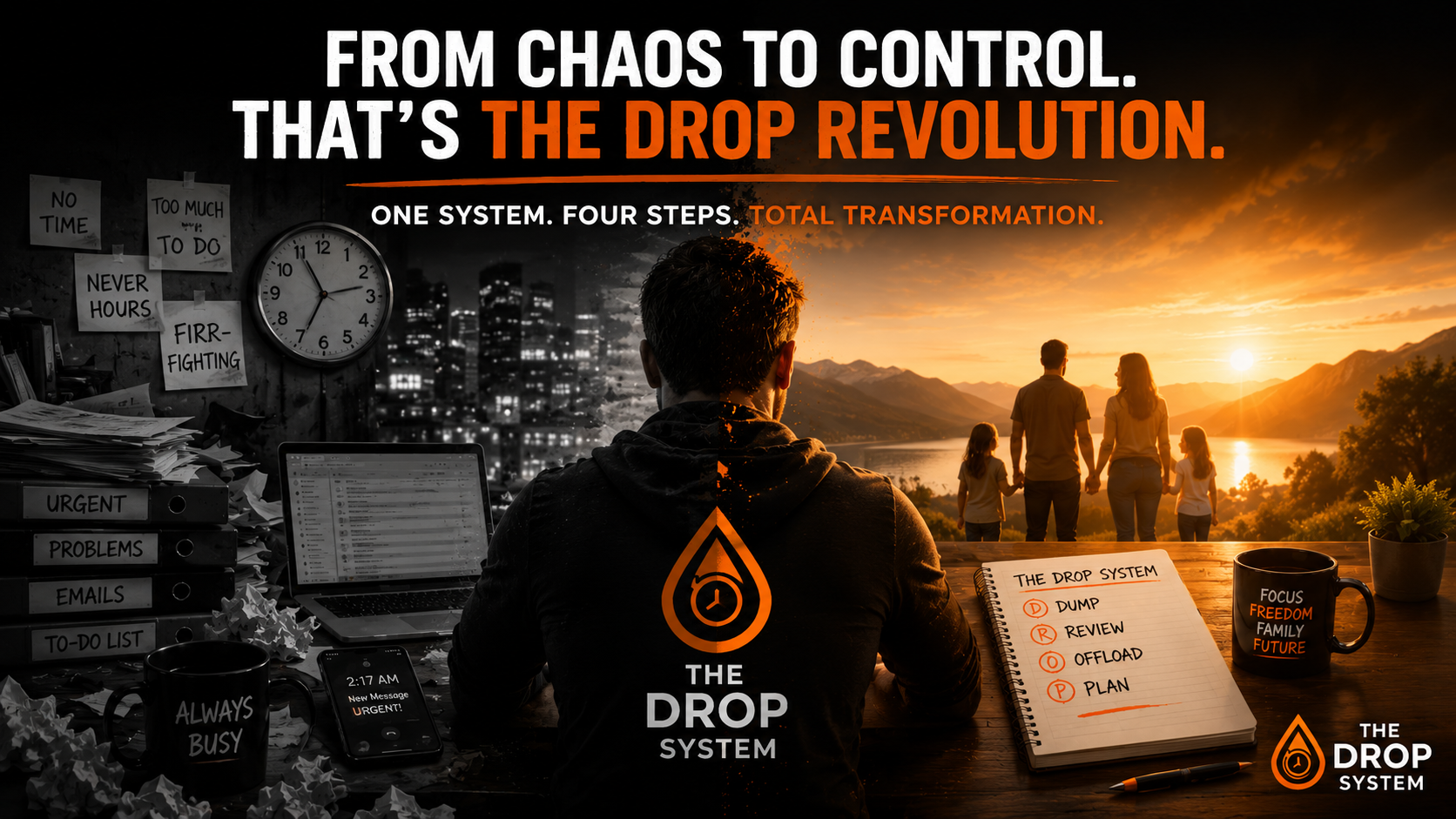
The DROP System stands for Dump, Review, Offload, Plan.
And while it started as a practical framework for managing time and workload, it also applies to attention and cognitive load.
Because if your brain is constantly full, you cannot think clearly.
You cannot review properly.
You cannot prioritise properly.
You cannot plan properly.
You cannot even tell what matters, because everything feels urgent when your mind is overstimulated.
Boredom gives you a signal.
It shows you what happens when the noise drops.
That signal might be uncomfortable at first.
You may notice restlessness.
You may notice tiredness.
You may notice how often you reach for your phone without thinking.
You may notice that your brain immediately starts looking for input.
That is useful information.
Not a failure.
Information.
The DROP approach is not about turning boredom into some romantic lifestyle trend.
It is about noticing what your attention does when nothing is pulling at it.
That awareness is where control starts.
Why Children Need Boredom Too
This conversation becomes even more important when we think about children.
Many adults grew up with boredom built into life.
Long car journeys.
Quiet Sundays.
Waiting around.
Playing outside.
Making things up.
Inventing games.
Finding something to do because there was nothing ready-made to consume.
Children today are growing up in a very different environment.
Entertainment is portable.
Stimulation is instant.
Screens are often available before boredom has even had time to appear.
Again, this is not about blaming parents.
Modern parenting is hard.
Life is busy.
Everyone is tired.
Sometimes screens are the thing that gets you through the day.
But if children never experience boredom, they lose the chance to practise what boredom creates.
Imagination.
Patience.
Self-direction.
Problem-solving.
Emotional regulation.
Independent thought.
Boredom is not cruelty.
It is part of development.
And one of the big challenges for modern families is learning how to let boredom exist without immediately treating it like a problem to solve.
If This Is Resonating
If this is resonating, you’ve got three options.
You can carry on reading and let it sit as awareness.
You can explore the books on Amazon</a> and start applying the framework in your own way.
Or, if you want structured support to actually install this properly and make it stick, you can join the DROP online training.
How to Start Rebuilding Boredom Tolerance
You do not need to disappear into the woods and throw your phone into a lake.
That is not realistic for most people.
Start smaller.
Let boredom return in tiny doses.
Try:
- making a cup of tea without checking your phone
- standing in a queue without scrolling
- driving for ten minutes without audio
- leaving your phone in another room for part of the evening
- going for a short walk without headphones
- letting your child be bored before offering entertainment
- sitting quietly for five minutes before bed
None of this is complicated.
But it may feel uncomfortable.
That discomfort is the point.
Not because suffering is good.
Because it shows how dependent your brain may have become on constant input.
You are not trying to become someone who never uses technology.
You are trying to become someone who can handle a quiet moment without needing to escape it immediately.
That is a very different goal.
Common Failure Modes
When people try to reduce stimulation, they often make one of three mistakes.
They go too extreme too quickly
They try to cut everything at once.
No phone.
No social media.
No background noise.
No television.
No apps.
That usually lasts about three days.
Then they bounce straight back.
You do not need a dramatic detox.
You need a realistic reset.
They confuse boredom with failure
The second things feel dull, they assume something has gone wrong.
Nothing has gone wrong.
That is the feeling you are rebuilding tolerance for.
They forget the emotional bit
Boredom often reveals feelings.
If you have been using constant input to avoid stress, tiredness, loneliness or frustration, quiet may initially feel heavier than expected.
That does not mean quiet is bad.
It means the noise was covering something.
The Future Belongs to People Who Can Sit With Their Own Mind
That might sound simple.
It is not.
In a world built to stimulate, distract and interrupt, being able to sit with your own mind is becoming rare.
And valuable.
The ability to be bored without panicking matters because it sits underneath deeper skills.
Focus.
Patience.
Creativity.
Emotional regulation.
Presence.
Reflection.
You cannot protect your attention if you cannot tolerate moments where nothing is happening.
You cannot think deeply if every gap gets filled.
You cannot recover properly if your brain is always being fed something new.
This is why boredom is not a trivial issue.
It is part of the bigger conversation around attention, distraction and cognitive protection.
It is part of The DROP Revolution because people are starting to realise the modern world is not just stealing their time.
It is stealing the quiet spaces where they used to meet themselves.
Summary
We no longer know how to be bored because modern life has trained us to fill every quiet gap with stimulation.
That does not mean people are lazy or broken.
It means attention has been conditioned.
Boredom used to create space for imagination, reflection, patience, emotional processing and deeper thought.
Now, many of those spaces are filled before they can do anything useful.
The answer is not rejecting technology.
The answer is rebuilding tolerance for low-stimulation moments.
Small gaps.
Quiet walks.
Phone-free queues.
Unfilled pauses.
Moments where the brain is allowed to settle.
Because boredom is not always the enemy.
Sometimes it is the doorway back to your own attention.
If you want to explore more of the wider work around attention, distraction and modern life, you can read more at https://www.adamfoxofficial.com
Or, if you want to go deeper into the books, you can explore the full collection on Amazon.
And if you want a practical framework designed for the modern world rather than the one we used to live in, Join the DROP System training
3 responses to “We No Longer Know How to Be Bored”
[…] We No Longer Know How To Be Bored […]
[…] We No Longer Know How To Be Bored […]
[…] We No Longer Know How To Be Bored […]