
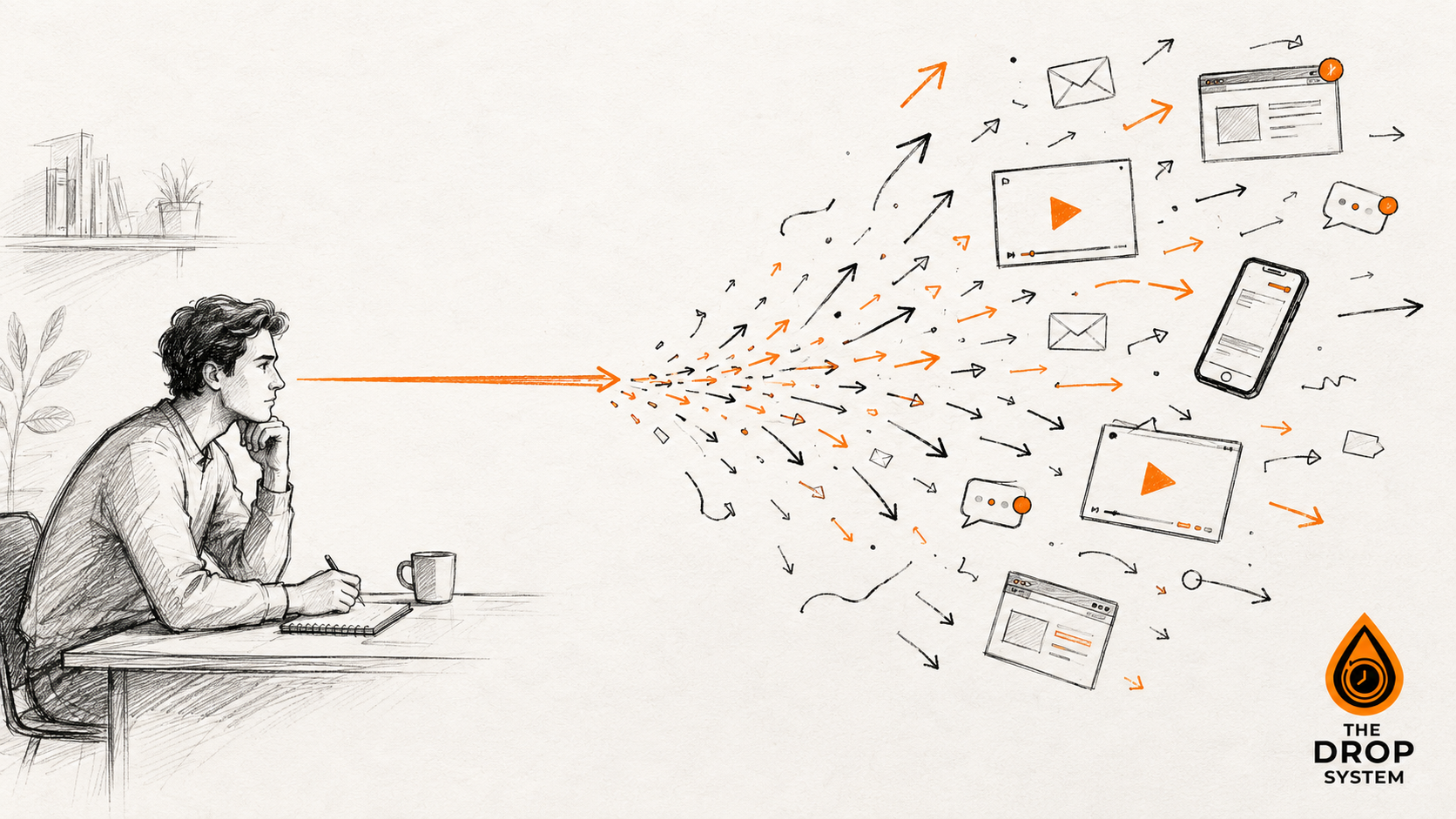
You sit down to read something important.
Within minutes, your hand reaches for your phone.
You start watching a film but feel the urge to check messages before the opening scene has finished.
You open an email, switch to another tab, remember something else, check a notification and then return to the email having forgotten what you were about to write.
You are not alone.
Millions of people feel as though their ability to concentrate has deteriorated.
They struggle to read.
They lose patience with long conversations.
They abandon videos that take too long to make their point.
They become restless during quiet moments.
They reach for stimulation whenever life slows down.
That is why modern attention spans are collapsing.
Not because human beings have suddenly become lazy, weak or incapable of thinking.
Because we are living inside an environment that repeatedly trains attention to move before it has had time to settle.
Our brains are adapting to the world we have built.
Unfortunately, the world we have built rewards interruption, speed and constant novelty far more than patience, reflection and depth.
Are Modern Attention Spans Really Collapsing?
It is tempting to reduce this entire conversation to a single claim:
“People cannot concentrate anymore.”
Reality is more complicated.
Your attention has not disappeared.
You can probably still focus intensely on something that feels urgent, emotionally engaging or immediately rewarding.
You might watch a gripping series for hours.
Spend an evening researching a holiday.
Lose track of time while working on something you genuinely care about.
The issue is not that human beings have completely lost the ability to focus.
The issue is that sustained attention has become harder to direct deliberately.
Modern attention spans are collapsing when we need to remain with something that is:
- Slow
- Difficult
- Uncertain
- Repetitive
- Unfamiliar
- Not immediately rewarding
That is a serious problem because many of the things that matter most in life fit those descriptions.
Learning a skill takes time.
Building a relationship takes patience.
Reading deeply requires effort.
Solving a complicated problem requires sustained thought.
Creating meaningful work rarely provides instant rewards.
When attention becomes dependent on constant stimulation, important things begin to feel unusually difficult.
Your Attention Is Being Trained Every Day
Attention is not simply something you either have or do not have.
It is shaped by repeated behaviour.
Every time you switch tasks because a notification appears, you reinforce the expectation that attention should move.
Every time you abandon a video because the opening is too slow, you reinforce impatience.
Every time you check your phone during a quiet moment, you teach your brain that stillness should be filled.
Every time you scroll through rapidly changing content, you practise scanning rather than concentrating.
No single action causes modern attention spans to collapse.
The problem is repetition.
Tiny behaviours performed dozens or hundreds of times every day gradually become the default way your brain operates.
This is why [link to: “Your Phone Is Training Your Attention Span”] matters. Your phone is not merely competing for your attention in the moment. The way you use it helps shape what your attention expects next.
The World Keeps Getting Faster
Modern technology constantly reduces waiting.
Messages arrive instantly.
Videos begin immediately.
Music changes at the tap of a screen.
Shopping takes seconds.
Answers appear before you finish typing the question.
Entertainment never ends.
Convenience can be useful.
But convenience also changes expectations.
When almost everything responds instantly, anything that requires waiting begins to feel frustrating.
A webpage taking five seconds to load feels slow.
A colleague taking a few hours to reply feels unresponsive.
A book taking fifty pages to develop an argument feels demanding.
A conversation that wanders before reaching the point feels inefficient.
The world has not merely become faster.
We have become less tolerant of anything that is not.
That impatience affects attention because sustained concentration requires accepting that worthwhile things often unfold gradually.
Short-Form Content Changes What Feels Normal
Short-form content is not automatically bad.
It can be funny, informative and useful.
The problem comes when rapidly changing content becomes the dominant way we consume information.
One clip ends.
Another begins.
Then another.
Each one has to capture attention immediately.
There is no introduction.
No slow build.
No room for uncertainty.
No requirement to remember what came before.
Your brain receives constant novelty with almost no effort.
Compare that with reading a book.
You must follow an argument.
Remember characters or ideas.
Build a mental picture.
Tolerate passages that are not immediately rewarding.
The difference is enormous.
When most of your information arrives in fast, emotionally stimulating fragments, slower forms of thinking can begin to feel uncomfortable.
That discomfort is one of the clearest signs that modern attention spans are collapsing.
Constant Context Switching Weakens Mental Momentum
Attention needs time to gain momentum.
When you remain with one task, your brain gradually builds context.
You remember what you have already considered.
You begin noticing patterns.
Connections become clearer.
The work becomes easier to hold in your mind.
Then something interrupts you.
An email.
A message.
A headline.
A thought about another task.
You switch.
The original mental context starts fading.
When you return, you have to rebuild it.
Many people repeat this process all day.
They never remain with anything long enough to reach depth.
That creates a strange experience.
You feel mentally busy because your attention has been active all day.
But you feel dissatisfied because very little received enough concentration to move forward properly.
As explored in [link to: “What Constant Input Is Doing to Your Brain”], receiving more information does not necessarily improve understanding. Often, it simply keeps your mind occupied.
Novelty Is Easier Than Effort
The brain naturally notices change.
Something new may be useful.
It could represent danger, opportunity or reward.
Modern platforms build around that instinct.
New post.
New message.
New clip.
New headline.
New reaction.
The content keeps changing, so your attention keeps moving.
A difficult task offers something very different.
The next paragraph may not be exciting.
The next stage of the project may resemble the previous one.
Progress may be slow.
The reward may be hours, days or months away.
Your brain is then presented with a choice:
Continue doing something demanding with an uncertain reward.
Or check a device offering immediate novelty.
It is not difficult to understand why the device often wins.
This is not evidence of personal failure.
It is the predictable result of placing high-stimulation tools beside low-stimulation work and expecting willpower to solve the difference.
We Have Removed Most Natural Pauses
Life once contained more unavoidable gaps.
Waiting for a friend.
Standing at a bus stop.
Sitting in a waiting room.
Travelling somewhere.
Waiting for food.
Watching adverts.
Standing in a queue.
Those moments gave the mind time to wander.
You noticed your surroundings.
Replayed a conversation.
Remembered something important.
Developed an idea.
Felt bored.
Then moved on.
Now almost every gap can be filled instantly.
The phone comes out before boredom has time to arrive.
That removes small opportunities for the brain to practise remaining unstimulated.
Over time, stillness starts feeling abnormal.
Modern attention spans are collapsing partly because we no longer allow attention to rest anywhere.
It is either actively working or being entertained.
There is very little in between.
Reading Exposes the Problem Quickly
One of the first places people notice declining attention is reading.
They read a page but retain almost nothing.
They feel an urge to check their phone.
Their eyes continue moving while their thoughts drift elsewhere.
They reach the end of a paragraph and realise they need to start again.
This can feel worrying.
But reading has not necessarily become impossible.
Reading simply reveals how accustomed your brain has become to novelty and interruption.
A book does not vibrate.
It does not automatically change subject every fifteen seconds.
It does not show you something new because you lost interest.
It asks you to bring the attention.
That is becoming harder precisely because so much of modern technology does the opposite.
It works relentlessly to capture attention for you.
Modern Attention Spans Are Collapsing at Work Too
The consequences extend far beyond entertainment.
Attention fragmentation changes the quality of work.
A person may spend eight hours at a desk while completing very little demanding work.
They respond to messages.
Attend meetings.
Check email.
Move between browser tabs.
Answer quick questions.
Deal with alerts.
Update systems.
None of these activities is necessarily pointless.
But together they can consume the entire day.
The work requiring real thought gets pushed later.
Strategy.
Writing.
Problem-solving.
Planning.
Creative work.
Difficult decisions.
These tasks require uninterrupted attention, yet they are often attempted in an environment built around availability.
The result is not simply lower productivity.
It is shallower thinking.
When nobody gets enough uninterrupted time to think, organisations become more reactive, more repetitive and less capable of solving difficult problems.
The Cost Reaches Beyond Productivity
It would be easy to treat collapsing attention spans as a workplace issue.
But attention determines far more than output.
It determines what you experience.
A conversation becomes shallow when you are waiting for your turn to check your phone.
A family meal becomes fragmented when everybody’s attention keeps leaving the table.
A walk becomes background scenery while you listen, scroll or message.
A film becomes something you half-watch while consuming something else.
A child’s story becomes harder to follow when work notifications keep appearing.
Modern attention spans are collapsing in the places where life actually happens.
That is the deeper cost.
We are not simply becoming worse at concentrating on work.
We are becoming less available for our own lives.
The DROP Lens: Attention Needs Protection
The DROP System stands for:
Dump
Review
Offload
Plan
Each stage reduces unnecessary demands on attention.
Dump removes the pressure to remember everything.
Review separates what matters from what merely arrived.
Offload removes tasks, commitments and information that should not continue occupying mental space.
Plan gives attention somewhere deliberate to go.
Most people try to improve focus by forcing themselves to concentrate harder.
That rarely solves the underlying problem.
You cannot protect attention while allowing every notification, request, thought and task to compete for it equally.
The DROP Revolution starts by reducing what your attention is expected to carry.
Because focus is not created through pressure.
It is created through clarity, boundaries and space.
If you want to explore practical ways to build more of that into your life, you can Explore the books or Join the DROP System training.
Can You Rebuild Your Attention Span?
Yes.
Attention adapts in both directions.
The same brain that becomes accustomed to constant switching can gradually relearn sustained focus.
But it requires practice.
Not dramatic digital detoxes.
Not throwing away every device.
Not pretending modern technology does not exist.
Practice.
Start with one activity receiving your full attention.
Read for ten minutes without checking anything else.
Complete one task with your phone in another room.
Take a short walk without audio.
Watch a programme without using a second screen.
Have a conversation with your phone out of sight.
These changes may feel strangely difficult at first.
That difficulty is not evidence that they are failing.
It is evidence that you are training something that has been neglected.
Stop Expecting Focus to Appear Automatically
Many people wait until they feel focused before beginning difficult work.
That is often backwards.
Focus develops after you begin.
The first few minutes may feel uncomfortable.
Your mind wanders.
You feel restless.
You remember unrelated tasks.
You want to check something.
Remain with the task.
The discomfort usually begins to settle once the brain accepts that no immediate novelty is coming.
This is similar to physical exercise.
The body becomes capable through repeated demand.
Attention becomes more stable through repeated periods of remaining.
You do not need hours.
You need consistent opportunities to practise.
Make Distraction Less Convenient
Willpower is unreliable.
Environment is often more powerful.
If your phone is beside you, you will think about it more.
If notifications are visible, they will compete for attention.
If email remains open, you will check it.
If every platform can interrupt you, eventually one will.
Reduce the number of decisions required.
Put the phone in another room.
Close unnecessary tabs.
Turn off non-essential alerts.
Work on one screen.
Choose when communication will be checked.
The aim is not to create a perfect environment.
It is to stop making distraction the easiest available option.
Give Your Brain Lower-Stimulation Experiences
You cannot live entirely inside high-stimulation environments and expect slow activities to feel natural.
Your brain needs contrast.
Read.
Cook without watching anything.
Walk without listening.
Sit outside.
Do one household task without reaching for your phone.
Let a queue remain a queue.
These experiences may appear insignificant.
They are not.
They teach your attention that a moment does not need constant novelty to be tolerable.
That lesson becomes increasingly valuable as modern attention spans are collapsing around us.
What Better Attention Actually Feels Like
Improved attention does not mean becoming permanently focused.
Nobody operates like that.
You will still become distracted.
Still lose interest.
Still check your phone unnecessarily.
Still have difficult days.
The difference is that you notice sooner.
You return more easily.
You can stay with demanding work for longer.
You feel less compelled to fill every pause.
You become more present during conversations.
You can read without fighting yourself on every page.
Your thoughts begin linking together rather than arriving as disconnected fragments.
Better attention does not make life perfect.
It makes life feel less scattered.
Summary
Modern attention spans are collapsing because our environment repeatedly rewards speed, novelty, interruption and constant switching.
Phones provide immediate stimulation.
Notifications train us to remain alert.
Short-form content makes rapid change feel normal.
Constant input fills every available pause.
Workplaces reward responsiveness over depth.
None of this means the human brain is broken.
It means the human brain is adapting.
That should concern us, but it should also give us hope.
Because what has been trained can be retrained.
You can create periods of uninterrupted focus.
You can reduce unnecessary input.
You can practise reading, listening and thinking deeply again.
You can allow quiet moments to remain quiet.
For a deeper understanding of how modern technology is reshaping concentration, read:
What Constant Input Is Doing to Your Brain
Your Phone Is Training Your Attention Span
Why Your Brain Craves Constant Stimulation
Modern attention spans are collapsing because attention is being pulled in more directions than ever before.
Protecting yours will not happen accidentally.
It requires conscious choices about what gets access to your mind, what deserves your focus and what can wait.
That is not about becoming more productive for the sake of doing more.
It is about becoming present enough to decide what is worth doing at all.
To explore these ideas further, Explore the books or Join the DROP System training.