
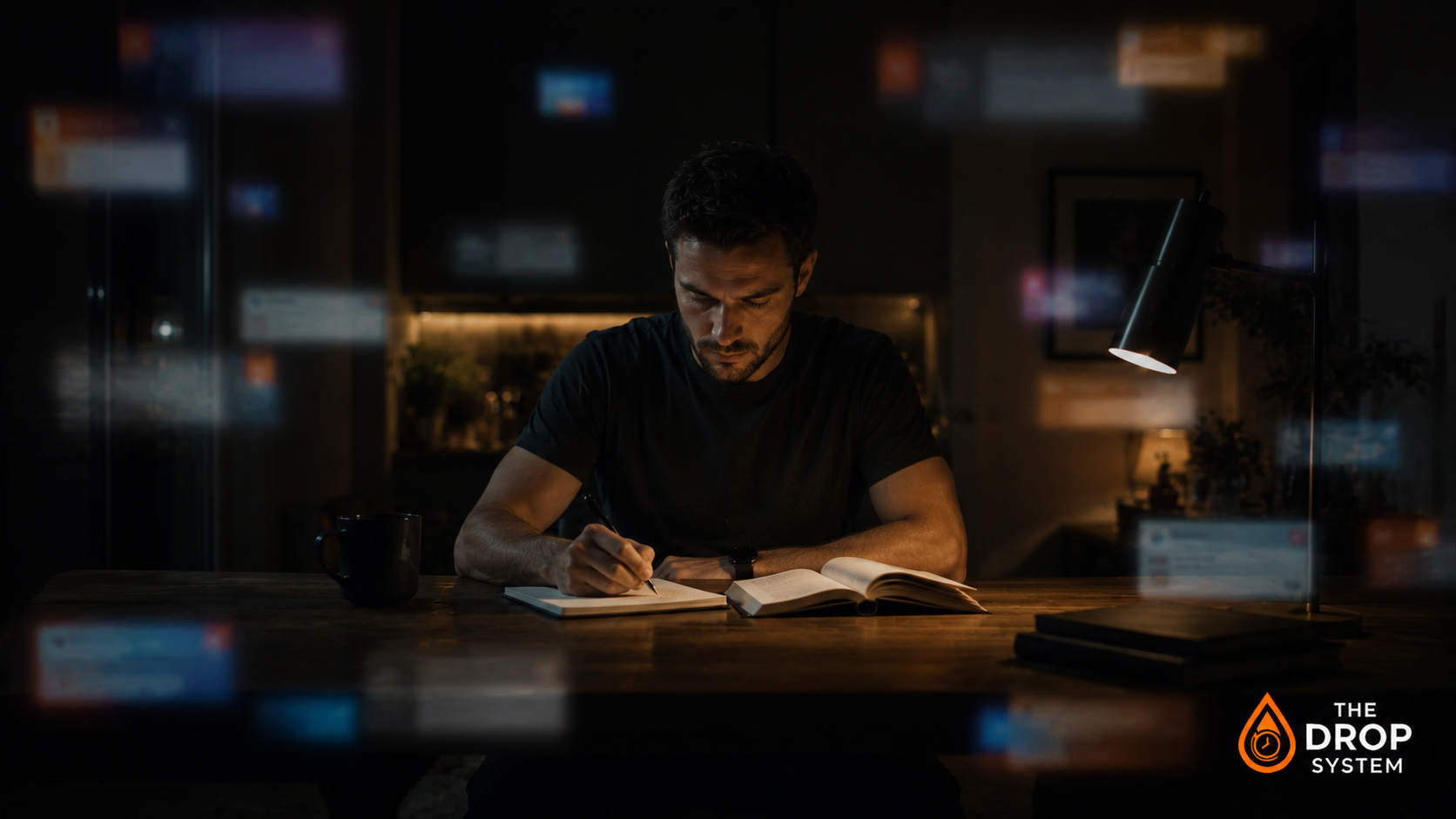
Most people think notifications are helpful.
A reminder.
A prompt.
A useful little nudge.
Something designed to keep us informed.
And occasionally, they are.
But that’s not the whole story.
Because notifications do far more than simply deliver information.
They influence behaviour.
They interrupt thought.
They redirect attention.
They shape decisions.
And they do it so subtly that most people never notice it’s happening.
That’s what makes them powerful.
If somebody walked into your office every seven minutes and demanded your attention, you’d probably tell them where to go.
If somebody interrupted every conversation, every meal, every meeting and every quiet moment, you’d find it annoying.
Yet many people willingly allow notifications to do exactly that all day long.
Not because they’re stupid.
Because the interruptions have become normal.
And normal things are rarely questioned.
Every Notification Is A Request
Most people see notifications as information.
A more useful way to think about them is as requests.
Every notification is asking for something.
Your attention.
Your time.
Your focus.
Your response.
Some requests are important.
Many aren’t.
The problem is that your brain often treats them similarly.
A message from your partner.
A marketing email.
A social media alert.
A calendar reminder.
A news update.
A sales promotion.
They all arrive in exactly the same way.
A sound.
A vibration.
A badge icon.
A banner.
And because they all arrive through the same channels, your brain starts reacting automatically before it has even decided whether the information matters.
Interruptions Carry A Cost
One of the biggest myths about notifications is that they only take a few seconds.
Technically, that might be true.
The notification itself might last two seconds.
The interruption does not.
Because attention doesn’t switch instantly.
You glance at the notification.
You think about it.
You decide whether it needs action.
You return to your original task.
Then your brain spends time rebuilding focus.
That process happens hundreds of times every week for many people.
The result is not simply lost time.
It is fragmented attention.
And fragmented attention makes everything feel harder.
Harder to think.
Harder to focus.
Harder to finish tasks.
Harder to stay present.
Your Brain Starts Anticipating Notifications
Here’s where things become really interesting.
Eventually, notifications don’t even need to arrive.
Your brain starts expecting them.
You check your phone before it vibrates.
You unlock your device without thinking.
You glance at your smartwatch.
You refresh your inbox.
You open social media.
Nothing happened.
Yet you checked anyway.
Why?
Because anticipation has become part of the habit.
This is one of the reasons people often feel drawn to their devices even when there are no alerts waiting.
The behaviour no longer depends on the notification itself.
The expectation becomes enough.
The Illusion Of Urgency
Notifications create a dangerous illusion.
They make everything feel urgent.
The email arrives now.
The message arrives now.
The update arrives now.
The alert arrives now.
Everything appears to demand immediate attention.
But urgency and importance are not the same thing.
Most notifications are not emergencies.
Most notifications do not require an instant response.
Most notifications would still be there in an hour.
Or tomorrow.
Or next week.
Yet people often treat every alert as if something terrible will happen if they don’t react immediately.
That mindset creates stress.
And stress creates more reactivity.
Which creates more checking.
Which creates more interruptions.
And the cycle continues.
The Hidden Impact On Relationships
Most conversations now compete with notifications.
Think about that.
You’re talking to your partner.
A vibration arrives.
Your attention shifts.
You’re having dinner with your children.
A banner appears.
Your attention shifts.
You’re meeting a friend.
A watch buzzes.
Your attention shifts.
Sometimes only briefly.
But attention moved nonetheless.
The problem isn’t just the interruption itself.
The problem is what those interruptions communicate.
The person sitting opposite you is no longer competing with another person.
They’re competing with an entire digital ecosystem.
And over time that affects presence.
Because presence requires uninterrupted attention.
Why Notifications Feel Impossible To Ignore
Human beings are naturally curious.
We’re wired to notice uncertainty.
We’re wired to investigate change.
We’re wired to seek information.
Notifications exploit all three.
The alert appears.
You don’t know what it is.
You don’t know who sent it.
You don’t know whether it matters.
Your brain wants closure.
The easiest way to get closure is to check.
So you check.
And the habit strengthens.
Again.
And again.
And again.
This isn’t a character flaw.
It’s a behavioural loop.
And once you recognise the loop, you start seeing notifications differently.
The Attention Tax Nobody Calculates
Imagine somebody charged you ten seconds every time they interrupted you.
It wouldn’t sound like much.
Now multiply it by fifty interruptions per day.
A hundred interruptions per day.
Two hundred interruptions per day.
Suddenly the cost becomes enormous.
But time isn’t even the biggest loss.
The bigger loss is attention quality.
Because attention works best when it stays in one place long enough to gain momentum.
Every interruption resets momentum.
Every notification forces your brain to start again.
And constantly starting again is exhausting.
The DROP Lens: Stop Letting Everything In
The DROP System stands for:
Dump
Review
Offload
Plan
Notice something important.
Review comes before action.
Modern notification culture encourages the opposite.
React first.
Think later.
DROP flips that approach.
Not everything deserves access to your attention.
Not everything deserves immediate action.
Not everything deserves a response.
One of the most powerful things you can do is create filters.
Because if everything can interrupt you, everything eventually will.
The goal isn’t becoming unavailable.
The goal is becoming intentional.
Mid-Article Reality Check
Most people don’t have a productivity problem.
They have an interruption problem.
They keep trying to improve focus while simultaneously allowing dozens of things to destroy it.
That’s like trying to fill a bucket while someone keeps drilling holes in the bottom.
At some point you have to address the holes.
That is one of the reasons The DROP Revolution resonates with people.
It focuses on removing unnecessary friction before adding more systems, apps and complexity.
If you’d like practical help applying that approach, you can Explore the books or Join the DROP System training.
How To Take Back Control
Most people don’t need to eliminate notifications.
They need to manage them.
Start with:
- Turning off social media notifications
- Removing non-essential app alerts
- Disabling promotional notifications
- Checking email at specific times
- Using Do Not Disturb during focused work
- Keeping phones out of reach during important conversations
- Creating notification-free periods each day
None of these changes are revolutionary.
But together they dramatically reduce attention fragmentation.
And attention fragmentation is often the real enemy.
What Happens When Notifications Stop Controlling The Day
At first, it feels strange.
You worry you’ll miss something.
You feel the urge to check.
You wonder what might be happening.
Then something interesting happens.
You start thinking more clearly.
You finish tasks more easily.
You become more present.
You feel less reactive.
You stop living at the mercy of every vibration and badge icon.
You realise most notifications weren’t nearly as important as they felt.
And that awareness changes everything.
Summary
Notifications seem harmless because each interruption feels small.
But small interruptions repeated hundreds of times create significant consequences.
Reduced focus.
Increased stress.
Fragmented attention.
Lower productivity.
Less presence.
We often assume notifications help us stay connected.
In reality, many of them simply keep us distracted.
If this article resonated with you, you may also want to read:
We No Longer Know How To Be Bored
Your Phone Is Training Your Attention Span
Why Your Brain Craves Constant Stimulation
The Psychological Cost of Infinite Scroll
Why Modern Life Feels So Noisy
Together, they explain why attention has become one of the most valuable and vulnerable resources in modern life.
And if you’re ready to stop reacting to everything and start focusing on what actually matters, you can Explore the books on Amazon or Join the DROP System training.