
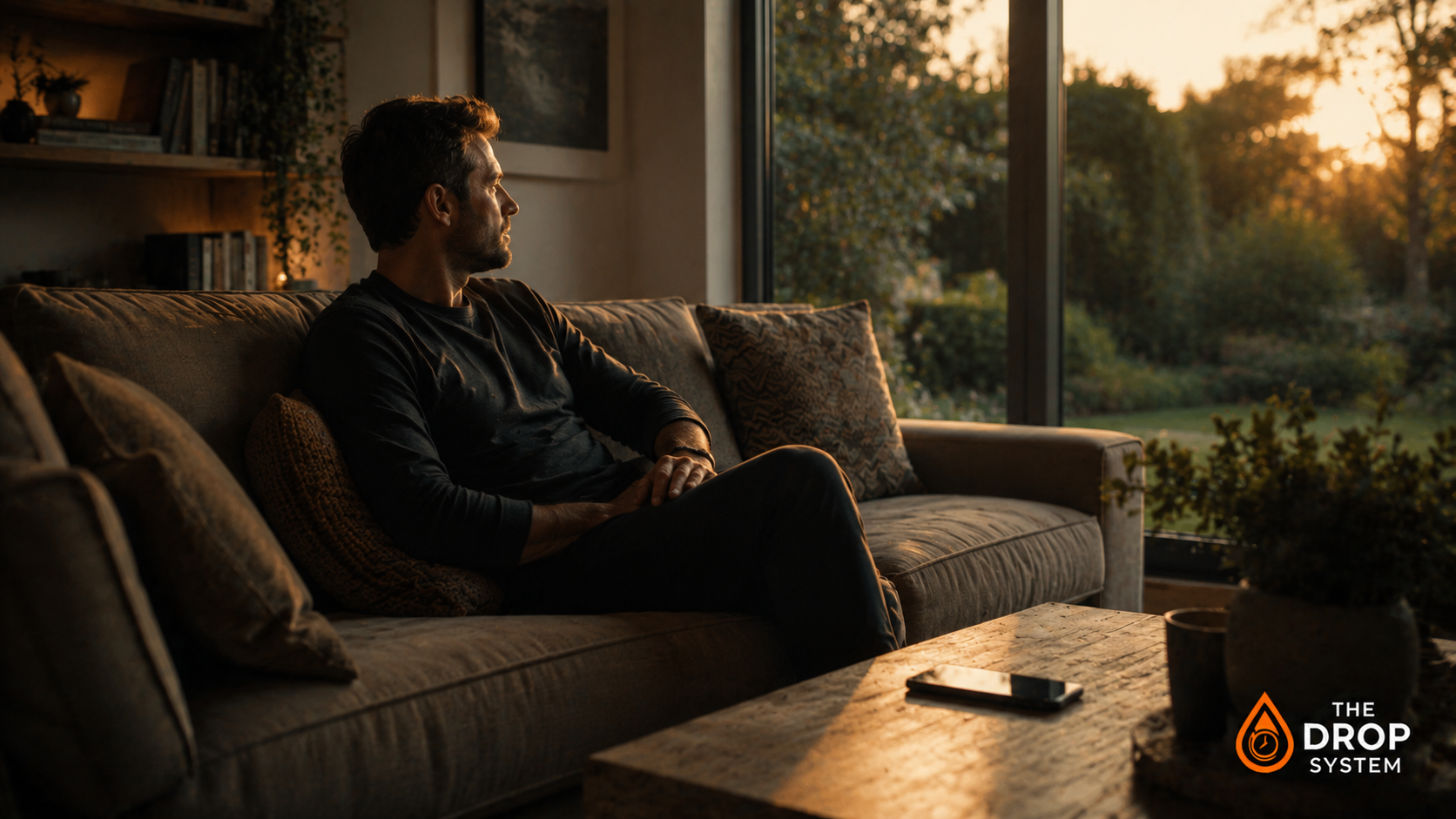
Have you ever sat down to relax…
Only to find yourself reaching for your phone within seconds?
Not because it rang.
Not because somebody messaged you.
Not because you actually needed it.
Just because it was there.
Or perhaps because it wasn’t.
For many people, the absence of their phone now creates a strange feeling.
A slight discomfort.
A mild anxiety.
An itch they can’t quite explain.
It’s become so normal that most people barely notice it anymore.
But it’s worth asking an uncomfortable question.
When did relaxing stop feeling relaxing?
When did sitting quietly become so difficult?
And why do so many of us feel the need to have a device within arm’s reach at almost every moment of the day?
The answer has very little to do with the phone itself.
It has everything to do with what the phone now represents.
Your Phone Has Become More Than A Device
Twenty years ago, a mobile phone had one primary purpose.
Communication.
Today it has become:
Your calendar.
Your camera.
Your sat nav.
Your diary.
Your notebook.
Your entertainment.
Your news source.
Your shopping centre.
Your music player.
Your bank.
Your work.
Your social life.
Your memories.
Your boredom killer.
Your source of reassurance.
It isn’t surprising that we feel attached to it.
We’ve gradually handed more and more parts of our lives over to one object.
The phone isn’t simply something we own anymore.
For many people, it has quietly become an extension of themselves.
The Comfort Blanket We Never Talk About
Watch what happens when someone realises they’ve left their phone at home.
Many experience immediate discomfort.
Not because they urgently need it.
Because they suddenly feel exposed.
Disconnected.
Unprepared.
Even vulnerable.
That reaction is fascinating.
Because it suggests the phone has become something more than a communication tool.
It has become emotional reassurance.
Knowing it’s nearby feels comforting.
Even if it never leaves your pocket.
Much like a child carrying a favourite toy or blanket, the object itself becomes associated with safety.
The difference is that adults rarely recognise the same pattern in themselves.
Relaxation Has Become Another Opportunity For Stimulation
Think about what relaxation used to look like.
Sitting in the garden.
Reading.
Watching the world go by.
Listening to birds.
Having a conversation.
Doing nothing for a while.
Now think about what “relaxing” often looks like today.
Watching television while scrolling.
Listening to music while checking emails.
Browsing social media while talking to family.
Replying to messages during a film.
Checking notifications between every chapter of a book.
The activity hasn’t disappeared.
We’ve simply layered another activity on top of it.
Relaxation has become consumption.
And consumption keeps the brain working.
The Fear Of Missing Something
There’s another reason many people struggle to put their phones down.
What if something happens?
A message.
An email.
A work issue.
A family emergency.
An invitation.
An opportunity.
Most of the time…
Nothing happens.
But your brain doesn’t know that in advance.
It only knows there might be something waiting.
That uncertainty creates anticipation.
Anticipation creates checking.
Checking becomes habit.
Habit becomes dependence.
Not because the phone is essential every minute.
Because the possibility of missing something starts feeling uncomfortable.
Presence Is Becoming A Rare Skill
One of the saddest consequences of constant phone access is what it steals from ordinary moments.
Waiting for your child outside school.
Walking the dog.
Having a coffee.
Standing in a queue.
Watching the rain.
Sitting in the garden.
These used to be moments where the mind wandered.
Now they’re often filled instantly.
Phone out.
Screen on.
Attention elsewhere.
The irony is that we’re often searching for stimulation during moments that never needed improving in the first place.
They just needed experiencing.
We Rarely Give Our Minds Chance To Settle
Imagine shaking a snow globe.
The water becomes cloudy.
Nothing is clear.
Leave it alone for a while…
And everything settles.
Your mind works in remarkably similar ways.
Every notification.
Every scroll.
Every email.
Every video.
Every alert.
It’s another shake of the snow globe.
Many people never leave it still long enough for clarity to return.
Then they wonder why their thoughts feel busy.
It’s difficult to think clearly when your attention never gets chance to settle.
The DROP Lens: Creating Space To Be Present
The DROP System stands for:
Dump
Review
Offload
Plan
People often assume it’s a productivity framework.
It is.
But underneath productivity sits something much more important.
Presence.
Because productivity isn’t really about getting more done.
It’s about creating enough space to enjoy the life you’re working so hard to build.
That becomes almost impossible if every spare moment belongs to your phone.
DROP encourages intentionality.
Not perfection.
Not digital abstinence.
Intentionality.
Choosing when your attention is available.
Instead of allowing every device to choose for you.
Mid-Article Reality Check
You don’t need to hate technology.
You don’t need to delete every app.
You don’t need to disappear from modern life.
The goal isn’t rejection.
It’s ownership.
Your phone should be a tool.
Not a reflex.
If reaching for it has become automatic, that’s not a reason for guilt.
It’s simply something worth noticing.
Because awareness is where control begins.
That’s one of the principles behind The DROP Revolution.
Helping people reclaim their attention without pretending they need to reject the modern world completely.
If you’re ready to take that next step, you can <a href=”https://amzn.to/4d3z7oU”>Buy the book</a> or <a href=”https://vllme8rwjgmxfhwzqavt.app.clientclub.net/courses/offers/1eaaf646-f41d-402a-af8c-a5be9ce1ccfc”>Join the DROP System training</a>.
Small Changes That Make A Big Difference
You don’t have to overhaul your life overnight.
Start by creating tiny moments where your phone isn’t invited.
Leave it in another room while eating dinner.
Go for a short walk without it.
Watch one film without checking it.
Read ten pages of a book before touching it.
Sit in the garden for five minutes with nothing but your own thoughts.
At first, those moments may feel surprisingly uncomfortable.
Stick with them.
Because what feels uncomfortable today often becomes peaceful tomorrow.
The Question Worth Asking Yourself
If your phone disappeared for a day…
Would you simply be inconvenienced?
Or would you feel genuinely unsettled?
The answer isn’t about technology.
It’s about dependence.
Most of us would survive perfectly well.
Yet many of us feel instinctively uneasy at the thought.
That feeling tells us something.
Not something to feel ashamed of.
Something to become curious about.
Because curiosity creates awareness.
Awareness creates choice.
And choice is where freedom begins.
Summary
Many people struggle to relax without their phone nearby because the device has gradually become far more than a communication tool.
It has become a source of stimulation, reassurance, habit and emotional comfort.
The problem isn’t owning a smartphone.
The problem is forgetting what it feels like to be fully present without one.
If this article resonated with you, you may also want to read:
We No Longer Know How To Be Bored
Your Phone Is Training Your Attention Span
Why Your Brain Craves Constant Stimulation
The Psychological Cost of Infinite Scroll
Why Modern Life Feels So Noisy
How Notifications Quietly Control Your Behaviour
Together, these articles explore why our relationship with attention has changed so dramatically and, more importantly, what we can do to take it back.
And if you’re ready to build a calmer, more intentional relationship with your time and attention, you can Buy the book or Join the DROP System training