
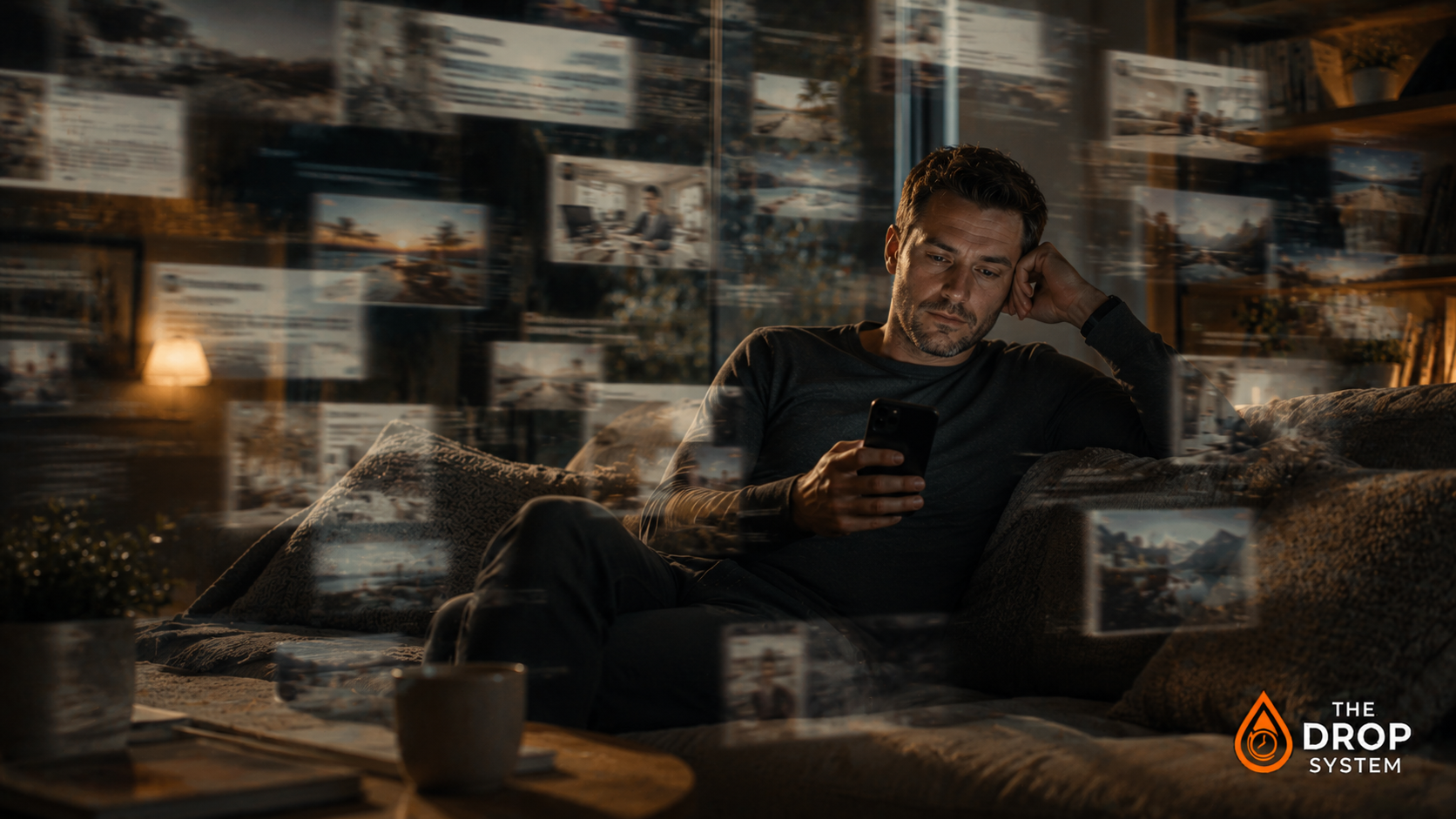
You open social media for five minutes.
Half an hour later, you put your phone down.
Nothing particularly bad happened.
You didn’t argue with anyone.
You didn’t read devastating news.
You didn’t watch anything especially upsetting.
And yet…
You somehow feel worse than when you picked it up.
More tired.
More distracted.
Less motivated.
Mentally full.
It’s a feeling millions of people experience every day, yet very few stop to ask why.
The answer isn’t that social media is inherently bad.
The answer is that your brain has just done far more work than you realise.
What feels like passive scrolling is actually an incredibly active mental process.
And that’s why so many people walk away feeling mentally drained.
Your Brain Never Stops Processing
Most people think they’re simply “looking” at social media.
They’re not.
Your brain is constantly working.
Every post is analysed.
Relevant or irrelevant?
Interesting or boring?
True or false?
Funny or offensive?
Agree or disagree?
Safe or threatening?
Your brain makes these judgements in fractions of a second.
Then immediately starts again with the next post.
And the next.
And the next.
An hour of scrolling might involve hundreds of these rapid-fire decisions.
No wonder your mind feels tired afterwards.
You’re Constantly Switching Context
Imagine trying to read a book where every paragraph came from a different author.
One paragraph is about war.
The next is a recipe.
Then politics.
Then someone’s holiday.
Then a funny dog video.
Then a business success story.
Then a tragedy.
Then football.
Then parenting.
Then climate change.
It would feel exhausting.
That’s exactly what most social media feeds look like.
Your brain has no opportunity to settle into one subject before it’s forced to process another.
Psychologists refer to this as context switching, and it carries a real cognitive cost.
Your attention isn’t simply moving.
It’s repeatedly starting again.
Emotional Whiplash
Social media isn’t just mentally demanding.
It’s emotionally demanding too.
Within minutes you might experience:
Amusement.
Envy.
Sympathy.
Anger.
Curiosity.
Frustration.
Excitement.
Concern.
Pride.
Disappointment.
No human conversation creates emotional shifts at that speed.
No book.
No documentary.
No walk in the countryside.
Your emotional state is being pulled in dozens of different directions every few seconds.
Eventually, your brain simply becomes tired.
Not because of one emotion.
Because of all of them.
Comparison Never Gets A Day Off
You’ve probably heard the phrase:
“Comparison is the thief of joy.”
Social media gives comparison an unlimited budget.
You compare careers.
Holidays.
Homes.
Bodies.
Relationships.
Businesses.
Children.
Cars.
Fitness.
Success.
Sometimes consciously.
Often unconsciously.
Even if you know people only post the highlights, your brain still absorbs the comparison.
That’s because your emotional brain responds long before your logical brain starts explaining why the comparison isn’t fair.
You’re Carrying Other People’s Problems
Think about everything you’ve seen online today.
A war.
Someone losing their job.
A charity appeal.
A political argument.
A missing person.
A celebrity scandal.
A friend’s illness.
A business closure.
An environmental crisis.
Your brain doesn’t simply ignore these things.
It stores them.
Processes them.
Feels something about them.
You may only spend ten seconds looking at each one.
But hundreds of tiny emotional reactions add up remarkably quickly.
Nothing Ever Feels Finished
One of the reasons social media feels mentally exhausting is that it rarely provides closure.
Stories continue tomorrow.
Arguments never end.
News keeps updating.
Comments keep arriving.
Videos keep playing.
Unlike reading a chapter in a book or completing a task, scrolling rarely gives your brain a satisfying sense of completion.
There’s always another post.
Another opinion.
Another update.
Your mind never quite reaches the point where it can say:
“I’m done.”
Your Attention Is Working Overtime
People often describe scrolling as “switching off.”
That’s rarely what’s happening.
Your attention is working incredibly hard.
Filtering information.
Ignoring adverts.
Recognising faces.
Reading text.
Watching movement.
Listening to audio.
Making decisions.
Predicting what comes next.
Remembering previous posts.
Comparing new information with existing beliefs.
That’s an extraordinary amount of cognitive work for something most people describe as relaxing.
The DROP Lens: Mental Energy Is A Limited Resource
The DROP System stands for:
Dump
Review
Offload
Plan
One of the biggest mistakes people make is assuming they only need to manage their time.
In reality, they also need to manage their mental energy.
Every unnecessary decision.
Every interruption.
Every comparison.
Every emotional reaction.
Every context switch.
They all consume a little more of that energy.
The goal isn’t avoiding social media forever.
The goal is becoming intentional about how much of your mental capacity you’re willing to give away.
Because once your attention is exhausted, everything else becomes harder.
Thinking.
Working.
Listening.
Being present.
Making decisions.
Even enjoying life.
Mid-Article Reality Check
This article isn’t arguing that you should delete every social media account.
Social media allows us to learn, connect and stay in touch with people we’d otherwise lose contact with.
Used intentionally, it’s an extraordinary tool.
Used unconsciously, it becomes an endless source of cognitive overload.
That’s one of the reasons The DROP Revolution exists.
Not to encourage people to reject modern technology.
But to help them use it without sacrificing their attention in the process.
If you’d like practical ways to do exactly that, you can <a href=”https://amzn.to/4d3z7oU”>Buy the book</a> or <a href=”https://vllme8rwjgmxfhwzqavt.app.clientclub.net/courses/offers/1eaaf646-f41d-402a-af8c-a5be9ce1ccfc”>Join the DROP System training</a>.
How To Leave Social Media Feeling Better
You don’t need to quit.
You need to become more deliberate.
Try:
- Decide why you’re opening the app before you unlock your phone.
- Set a clear time limit before you start scrolling.
- Follow people who educate or inspire rather than simply provoke.
- Unfollow accounts that consistently leave you feeling inadequate or anxious.
- Spend at least as much time creating as consuming.
- Take regular breaks where your brain isn’t processing anyone else’s life.
None of these changes are dramatic.
But together they reduce the mental load considerably.
Your Brain Wasn’t Built For Endless Input
Human beings evolved to process relatively small social groups.
Not thousands of people.
Not global news twenty-four hours a day.
Not an infinite stream of opinions, videos and emotional triggers.
Your brain isn’t failing.
It’s responding exactly as we’d expect when exposed to an environment it was never designed for.
Understanding that should feel reassuring.
Because it means you’re not broken.
You’re human.
And once you understand what’s happening, you can begin making different choices.
Summary
Social media leaves many people mentally drained not because scrolling itself is difficult, but because of everything happening beneath the surface.
Constant context switching.
Emotional overload.
Comparison.
Decision-making.
Information processing.
Unfinished stories.
Together, they place a significant demand on your attention and mental energy.
The answer isn’t abandoning technology.
It’s becoming more intentional about how you use it.
If this article resonated with you, you may also want to read:
We No Longer Know How To Be Bored
Your Phone Is Training Your Attention Span
Why Your Brain Craves Constant Stimulation
The Psychological Cost of Infinite Scroll
Why Modern Life Feels So Noisy
How Notifications Quietly Control Your Behaviour
Why You Can’t Relax Without Your Phone Nearby
The Real Reason You Check Your Phone Constantly
Together, these articles explain how modern technology quietly shapes your attention, behaviour and mental wellbeing—and how The DROP System can help you take that control back.
If you’re ready to reclaim your attention and build a calmer, more intentional way of living, you can Buy the book or Join the DROP System training.